I put on my old denim jacket, took the folder, and went onto the porch.
The driveway retained the afternoon heat. The small American flag by the mailbox snapped in the breeze, and the screen door squealed against its spring.
At precisely 4:26 p.m., an SUV turned off the road.
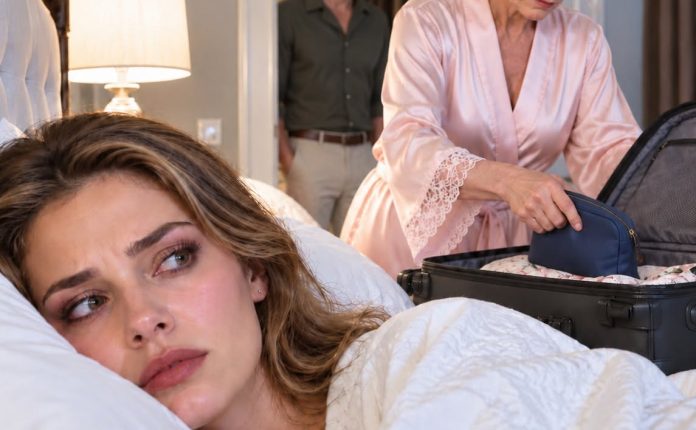
Sienna sat up front wearing sunglasses, smiling before they stopped. Beverly rode behind with a travel pillow around her neck, while Gordon hugged a banker’s box, apparently certain someone had already made room for its contents.
The hatch lifted, revealing two suitcases.
Sienna got out, surveyed the cabin beyond me, and said:
Good. You’re ready.
I opened my blue folder against the porch rail. For the first time in seven years, her confident smile faded before I even spoke.
PART 2
I turned to the deed, displaying my name—the only one recorded—along with the county seal and property’s description for Sienna, Beverly, and Gordon.
No one said anything. Water brushed the stones below the lawn, and the screen door creaked behind my back.
Sienna finally declared the whole thing absurd because family shouldn’t need documents.
I laid out the property-tax receipt, then the insurance page, then a printout of her message:
“Don’t embarrass everyone over empty rooms.”
Beverly studied it briefly. Her expression changed ahead of Sienna’s. She had come equipped with a travel pillow and luggage, not expecting to find her arrival documented as evidence.
Gordon put his banker’s box on the gravel with a muffled thud. Rather than looking at me, he turned to his daughter-in-law.
That reaction revealed something: Sienna must have described this arrangement differently during the drive. Perhaps she’d said I offered, or Elliot had handled it, or that I was being stubborn but would eventually agree.
Whatever her version, it hadn’t featured legal ownership records and her own remarks in print.
I set the unused rental contract on top. Its terms were uncomplicated: market rent, a security deposit, specified dates, and no automatic entitlement to bedrooms or storage. It certainly didn’t convert my home into a family holiday resort merely because someone found that convenient.
Sienna looked as though I’d struck her with the papers.
I hadn’t. That distinction mattered. I’d done nothing vindictive; I’d simply put the facts in front of everyone.
She accused me of embarrassing her parents. I replied that I hadn’t invited them into an embarrassing situation. It was the sharpest I allowed myself to sound.
Beverly quietly asked Sienna exactly what Elliot had agreed to. Sienna hesitated, and that hesitation did more than any speech I could have delivered.
Her phone vibrated. Elliot’s name shone on the screen between us.
Sienna attempted to step away, but the porch was small and the truth was already out in the open.
I asked her to use speakerphone. She stayed still, so I extended my hand. Perhaps because everyone was watching, she handed over the phone.
I answered with my son’s name. Elliot was bewildered: why had Sienna repeatedly called while he was driving home from work?
I repeated the question I’d asked her the previous evening. Had he consented to Beverly and Gordon living in my cabin all summer?
There was a pause—not the silence of someone caught lying, but of a man reconstructing what he thought he’d heard from his wife.
Then he said no.
One word, and the entire scene shifted.
Sienna went pale. Beverly shut her eyes. Gordon lifted his box from the ground and held it against his chest, no longer moving toward the doorway.
Elliot wanted to know what was happening. I didn’t dramatize it. I read Sienna’s text, followed by the first line of my rental agreement, and explained that her parents’ luggage was already in my drive.
Silence followed. I heard traffic on his end and my own breathing on this one.
I’d spent years shielding Elliot from having to choose between adults whenever possible. His mother’s departure had taught me how unfairly grown-ups could place their decisions on children.
But Elliot wasn’t thirteen anymore. He was a husband and a son, caught in a situation his wife had tried to organize without him knowing its full truth.
He asked to speak with Sienna. I returned the phone and she stepped off the porch. We didn’t need to overhear her words; her posture gave away enough.
Initially she stood rigid, chin raised, hand planted on her hip as though sheer confidence could settle everything. Then her arm dropped. She turned away from her parents and spoke Elliot’s name in a voice smaller than I’d ever heard from her.
Beverly perched on the SUV’s seat, rubbing the bridge of her nose.
Gordon finally faced me and explained he’d been told that I wanted company and that the cabin arrangement was settled.
I believed him. Not because he deserved unlimited trust, but because his embarrassment seemed genuine. A liar usually works hard to keep his expression animated. Gordon’s face was motionless.
I apologized to them for how they’d been brought into this, while making it clear the cabin wasn’t available. I could recognize the discomfort of two people arriving under a false impression without accepting responsibility for creating that impression myself. Both things could be true. Being kind needn’t mean yielding.