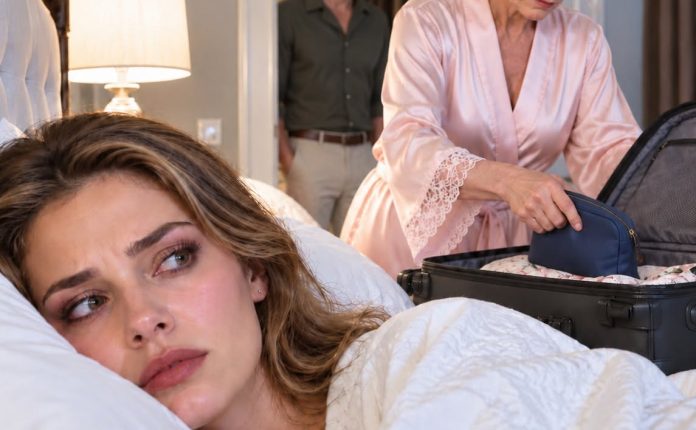
As the line rang, I looked back at the man I had lived with for over a decade. He was practically vibrating with the delusion of unearned wealth. He had no idea that when you build an empire out of spite, the foundation is made of sand.
“Michelle,” I said when the call connected. “Pack the guest bed. Ruby and I are coming over.”
“Amanda?” my sister’s voice came through sharp and alert. “What happened?”
“Kevin brought his replacement home with a suitcase,” I said clearly, staring directly into Alexis’s cold, mascara-rimmed eyes. “And he thinks he just bought the world.”
Kevin lunged forward to seize the telephone base, ripping the cord straight out of the drywall jack, his eyes wild with a sudden, violent realization that I was not going to break down and beg.
Part 2: The Stool in the Dust
The drive north from Overland Park to Michelle’s split-level home in Lenexa was an exercise in absolute emotional suppression. In the rearview mirror, Ruby’s eyes reflected the passing yellow glare of highway streetlamps. She clutched a threadbare stuffed rabbit to her chest, her small legs swinging rhythmically against the front passenger seat.
“Mommy?” her small voice piped up above the hum of the heater. “Did Daddy buy a new friend for the house?”
My fingers tightened around the worn leather of the steering wheel until my knuckles turned ivory. “No, sweetie. Daddy just had a guest who didn’t understand good manners.”
“Is Grandpa coming to Aunt Michelle’s house too?”
A physical ache blossomed behind my sternum. Donald Murray had been the only member of that family who treated integrity as an absolute requirement rather than an inconvenience. He was a retired master carpenter and tool-and-die inspector—a man with calloused, square hands who could spot a three-millimeter deviation in a structural beam from thirty paces away.
That past July, when Donald was still able to move between his kitchen and his detached garage workshop, he had spent two weeks crafting a solid oak step stool for Ruby. He had used an old pyrography iron to burn her name into the grain of the seat: RUBY JANE, BUILT TO STAND TALL. She had carried that stool everywhere—to the bathroom sink to brush her teeth, to the counter to help me roll pie crusts.
I had been forced to leave that stool behind by the kitchen island when I threw three suitcases into the trunk.
“Grandpa is resting now, baby,” I whispered softly. “Remember what we talked about at the hospital?”
“He’s asleep in the quiet place,” she recited dutifully, her eyelids growing heavy. “Where the wood smells good.”
“That’s right, my love. Where the cedar smells good.”
Six weeks before he passed, Donald had sat with me on the unfinished treated-lumber back steps of his workshop. His hands had trembled slightly around a chipped mug of black coffee, his body visibly deteriorating from the malignancy consuming his lungs. Kevin had been supposed to visit him that afternoon to assist with winterizing the gutters; instead, Kevin had texted an excuse about an emergency sales conference in Lake of the Ozarks. I later discovered that ‘sales conference’ was the weekend he purchased Alexis a three-carat tennis bracelet on an overdrawn credit card.
Donald had stared out over his backyard garden, his voice a low, raspy rumble. “Amanda,” he had said without turning his head. “A weak man thinks wealth is something you take. A strong man knows wealth is something you carry. One day soon, someone is going to ask you to take on a burden that doesn’t feel fair. They’re going to ask you to protect what matters from people who only know how to consume. Don’t you dare let Kevin make you feel guilty for saying yes.”
At the time, I had assumed he was speaking about the general emotional toll of his approaching death, perhaps asking me to manage Kevin’s erratic grief.
Now, cruising past the dark industrial parks of Johnson County, Donald’s gravelly words struck me like an iron weight dropped into deep water. He wasn’t talking about grief. He had seen the fault lines in his own son long before I had the courage to name them.
My phone chimed on the console. It was a message from Joyce Murray, Kevin’s mother.
Joyce had spent thirty-five years living in an emotional fortress of southern-style suburban passive-aggression, perpetually convinced that her only son was an unrecognized titan of industry whose greatness was held back by the women around him. When Kevin and I married, Joyce had gifted me a book on household etiquette with specific passages underlined concerning “supporting an ambitious provider.”
I pulled into Michelle’s driveway and tapped the screen:
Amanda. Kevin informed me of your hysterical departure. It is for the best. Donald’s sudden passing requires that this family present a unified, dignified front. We cannot have scenes at the church. Donald would have wanted us to move forward without dead weight. Do not come to the house tomorrow.
I read it twice. My breath puffed white in the cold air of the parked sedan.
Dead weight.
Eleven years of balancing Donald’s medical billing statements. Eleven years of organizing Joyce’s prescription refills because Kevin couldn’t be bothered to drive across town. Eleven years of ensuring property taxes on Donald’s rental houses were reconciled down to the half-cent.
“Amanda?” Michelle’s front porch light flicked on, cutting through the darkness. She came down the steps in a thick knit cardigan, her face grim. She didn’t ask questions; she simply reached into the backseat, lifted Ruby into her arms, and nodded toward the front door. “Get inside before your fingers freeze.”
Over a cup of chamomile tea an hour later, while Ruby slept soundly under a handmade quilt in the spare bedroom, Michelle watched me systematically photograph every household bank statement I had brought in my leather briefcase.
“He actually brought her to the house?” Michelle whispered, her hands trembling with rage. “Two days after Donald died? While you were making dinner?”
“He thinks he’s king of the county now,” I said, my voice eerily calm as I updated an Excel spreadsheet on my laptop. “He believes Donald’s four million dollars will insulate him from the consequences of being a sociopath.”
“Can he kick you out legally? Just like that?”
“No,” I replied, clicking a cell shut. “The house is titled in both our names. It’s a marital asset. But Kevin doesn’t care about the law right now because he assumes I don’t have the liquidity to fight him. He thinks I’ll take a pittance out of exhaustion.”
“And will you?” Michelle leaned across the kitchen table, searching my eyes.
I looked at the small pile of paperwork: our marriage certificate from a hot June afternoon eleven years ago, the birth certificate for Ruby, and the bank statement showing my freelance bookkeeping reserve: $7,241.18.
“Donald told me not to let Kevin make me feel guilty for standing my ground,” I said softly, the exhaustion finally pulling at the corners of my vision. “I don’t know what Donald did before he died, Michelle. But I know how Donald built his cabinets. He never left a joint unglued, and he never trusted a load-bearing wall to rotten pine.”
Before I could close the laptop, a formal electronic notification chimed in my inbox.
The subject line was crisp, official, and sent directly from the legal offices of Freeman, Vance & Sterling, LLC in downtown Kansas City:
Notice of Mandatory Trustee and Beneficiary Assembly: In Re the Donald E. Murray Revocable Living Trust.
Attached was a summons from Marilyn Freeman, Donald’s personal attorney of three decades. The meeting was scheduled for Tuesday morning at ten o’clock sharp.