The volunteer form was approved that afternoon.
Pike called me himself.
“The pool meets Tuesday evenings. Come whenever you can.”
So I did.
The first Tuesday, I wore my Army green service uniform.
I did that intentionally.
Not because I wanted people impressed.
Because the young people in those folding chairs deserved to see the whole uniform on an ordinary human standing three feet away.
The ribbons.
The bun.
The way the jacket actually sits on shoulders after years of wearing one.
A poster can become mythology.
A person has to find parking.
Sutter ran the board that night.
He had changed.
Not dramatically.
That was how I knew the change was real.
An older man walked in asking about options for his daughter.
I watched the first half-second of assumption appear in Sutter’s face.
Then I watched him catch it.
He put the assumption down.
Started again.
Asked a question.
Actually listened to the answer.
For one second, his eyes flicked toward me.
Checking whether I had noticed.
I had.
I did not make a production of it.
You should not turn somebody becoming better into a performance they have to repeat for your approval.
You let them catch you noticing once.
Then you look away.
Sergeant Alvarez turned out to be the sharpest recruiter in the station.
She was also the junior one.
Quiet.
Easy for a busy room to talk over.
I recognized the pattern.
So I began asking Alvarez questions in front of Pike and Sutter.
Real questions.
The kind you only ask when you genuinely want the answer.
Watching a room slowly learn to hear a person it had been speaking over became one of the cleaner pleasures of those Tuesdays.
One evening in the fall, a seventeen-year-old girl arrived with her mother.
Both were frightened in different ways.
The girl was worried about leaving.
The mother sat with her arms crossed tightly.
People often read crossed arms as anger.
Sometimes it is just a person holding themselves together.
Sutter worked through the paperwork.
Then he did something I had not taught him directly.
He put the folder down.
Looked at the mother instead of the daughter.
“Ma’am, I’m not going to promise your daughter will always be safe.”
The mother’s expression changed.
Sutter continued.
“You’d know I was telling you something I can’t guarantee, and then you wouldn’t trust anything else I said.”
Her arms loosened slightly.
“What I can tell you is she’ll be trained by people whose job is to prepare her and bring her home. And I’ll give you my personal number. If you need to call me at two in the morning because you’re worried, call.”
The mother’s arms uncrossed.
I watched it happen.
I said nothing.
I went to refill the coffee.
Years earlier, a colonel had told me to make coffee because he had misread who I was.
That evening, I made coffee because I wanted the room to belong to Sutter for a few minutes.
It did.
He had earned it.
That was the recruiter I had seen hiding inside the man with the ball cap.
I happened to be right.
That is not always how these stories go.
I do not take much credit for it.
People eventually decide who they are going to become.
Sometimes the best thing another person can do is refuse to become the reason they stop trying.
The eighteen-year-old with the nervous elbows—the first one who had asked me about the blue ribbon—kept coming to Tuesdays.
He was afraid of shipping.
Not the physical work.
Leaving.
First person in his family to do anything like this.
His mother cried.
His girlfriend did not understand.
He still owed money on his car.
Every one of those things was a rope tied to the dock.
Shipping day was when every rope pulled at once.
I knew that feeling.
On his second Tuesday, I sat beside him.
I did not give him a speech about honor.
People who are scared do not need speeches.
They need useful truths.
“The fear doesn’t mean you’re making a mistake,” I told him.
He looked unconvinced.
“It means you understand what you’re doing.”
He stared at the floor.
“The ones who feel no fear at all are the ones I worry about.”
That got a small smile.
“Your job isn’t to stop being scared before the bus comes.”
I leaned back in the folding chair.
“Your job is to keep the promise you made to yourself while you’re scared.”
He nodded.
“One day at a time. That’s how people carry heavy things. Nobody carries the whole weight at once.”
He shipped.
He made it through training.
Later, he started sending Sutter occasional messages from his duty station.
Sutter read some of them aloud to the pool.
That mattered.
Young people waiting in folding chairs need to hear from somebody who used to sit in the same chair and is now on the other side.
That is recruiting too.
Looking.
Then keeping them warm.
Somewhere in those Tuesdays, I began to understand something about Danforth.
I never found her.
I tried.
The trail from a processing warehouse in 2008 did not lead far.
Reservists scatter.
Names repeat.
People retire.
Records do not always preserve the human connection you wish they did.
I never got to say I was sorry.
For years, I treated that unfinished apology like a debt that could only be paid to one person.
Then the Tuesdays changed my mind.
Sometimes you cannot pay a debt directly to the person you owe.
Sometimes they are gone.
Sometimes you never knew enough to find them again.
What you can do is recognize the next person standing where they once stood.
Danforth stood at the back of a processing line with a reasonable question and was told by a young sergeant to wait outside.
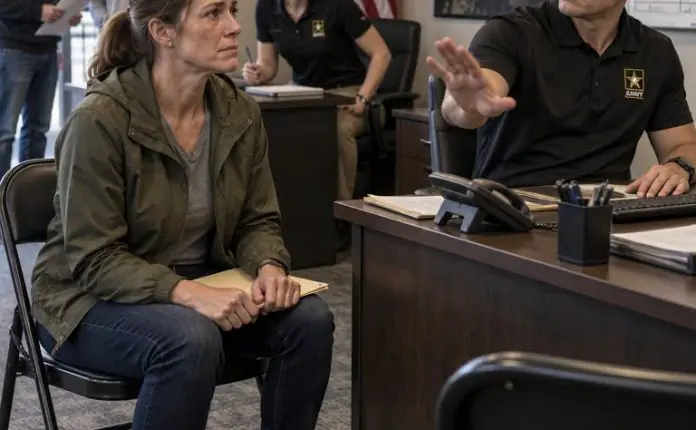
Eighteen years later, I sat on a folding chair with a reasonable request and was told by another young sergeant to go home and cook.
The line runs in both directions.
The only thing I could do for the person behind me was refuse to repeat what had been done to me.
The only thing I could do for the woman I had wronged was become someone who would not make that mistake again—and prove it in places where she would never see.
So I answered Danforth.
Not with the sentence she deserved.
With Tuesdays.
With Alvarez being asked questions people should have been asking her already.
With a frightened recruit being talked across his shipping day.
With Sutter learning to pause before deciding who had walked through his door.
That became the apology.
Her name was not written on it.
Maybe the better apologies rarely are.
The recruiting poster remained beside the door.
Over time, I made a kind of peace with sharing a room with it.
For years, I wanted that photograph taken down.
I thought it lied.
It showed a composed woman wearing a ribbon that other people associated with courage.
I remembered a terrible day and the person I could not reach in time.
Eventually, I allowed another truth to sit beside the first.
The poster brought young people through the door.
Some of those young people would become the people who go back for somebody who needs them.
Some would get there in time because they were better trained, better prepared or slightly less alone.
If an unsmiling photograph from the hardest day of my life helped put one more prepared person between someone else and disaster, then maybe the photograph could stay.
And maybe I could stand beside it on a Tuesday.
The woman in the poster.
The woman in the folding chair.
The End
Read more original stories on Feel Every Story.