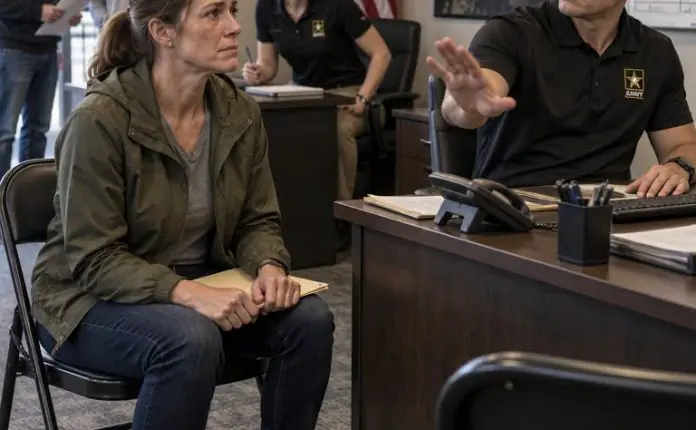
When the emergency happened, there were three people who needed to be moved.
I made a decision about the exposed ground.
I would make the same decision again.
That does not mean I enjoy remembering it.
I helped two of them reach a place where medical care could begin.
Then I went back for Maddox.
I did not get him there in time.
The Army later gave me the Silver Star for what happened that day.
People usually focus on the two I reached.
I remember the third.
There is no ribbon for the person you could not bring back.
There is only an old envelope in a drawer with a garage drawn on the back.
And a font selected by a twenty-two-year-old who expected to use it.
Three years later, when a photographer asked me to smile for an official portrait, I could not.
He asked again.
I tried.
Eventually, he understood.
He took the photograph anyway.
That became the poster.
I wrote to Isaac’s brother after I came home.
It took four months.
I drafted the letter again and again.
The version I finally mailed was probably the eleventh.
It still was not right.
No version could have been.
His brother wrote back one sentence.
“Thank you for going back for him.”
I have read that sentence more times than my own citation.
It was kinder than I believed I deserved.
Eventually, I decided to let it be true anyway.
Maybe he needed it to be true.
Maybe I did too.
The two others we got to help survived.
One of them has three children now.
Every year around the anniversary, he sends me a photograph.
The three kids stand on a porch.
Every year they are taller.
He never writes anything with the picture.
I never answer with words.
There is nothing useful to say.
The photograph is enough.
Proof that the worst day did not take everybody.
That is what the ribbon becomes when you turn it over.
Not a story about bravery.
A short list of people still standing on porches.
And the weight of someone who is not.
That was why I could not smile for the photographer.
That was the photograph hanging behind Staff Sergeant Sutter when he told me to go home and cook.
Strangely, I have never been deeply angry about that sentence.
Anger would require me to believe the poster is primarily about me.
It is not.
If there is one name inside it I would defend, it is Isaac Maddox’s.
When it was finally time for me to leave the station that first morning, Sutter walked me to the door.
He held his ball cap in both hands and kept turning it slowly by the brim.
At the door, directly beneath the poster, he stopped.
“Sergeant First Class.”
I faced him.
He forced himself to meet my eyes instead of the floor.
That took effort.
I respected the effort.
“I don’t have a good excuse.”
I waited.
“I’m not going to build one.”
He glanced toward his desk and back.
“I looked at you and decided I already knew who you were. I was wrong.”
His fingers turned the cap once more.
“And I said something I’d be furious to hear somebody say to my mother.”
He swallowed.
“I’m sorry.”
Then he gave me one of the better apologies I have ever received.
“I’m probably going to be sorry about it for a long time. I think that’s fair.”
He did not ask me to forgive him.
He did not ask me to tell him everything was fine.
He simply put the apology between us and allowed it to stand there.
“Staff Sergeant.”
“Yes, Sergeant First Class.”
“The best recruiters I ever met could look at somebody everyone else would walk past and see the soldier hiding in there.”
He listened.
“That is the job.”
I nodded toward the whiteboard.
“You already have the hard parts. Filled ship dates. Green numbers. Twelve-hour days.”
Then I nodded toward the door.
“Learn the looking.”
His expression tightened.
“Start with the next person who walks through that door in a windbreaker.”
He nodded.
Once.
Then again.
A beat longer than necessary.
“Yes, Sergeant First Class.”
I walked into the heat.
The parking lot still radiated through the soles of my shoes.
I sat in my car for a minute before starting it.
I let the morning be exactly what it had been.
Then I drove home.
That could have ended the story.
A woman leaves with her dignity intact.
A young recruiter remains behind thinking hard.
A lesson.
The end.
Except I went back.