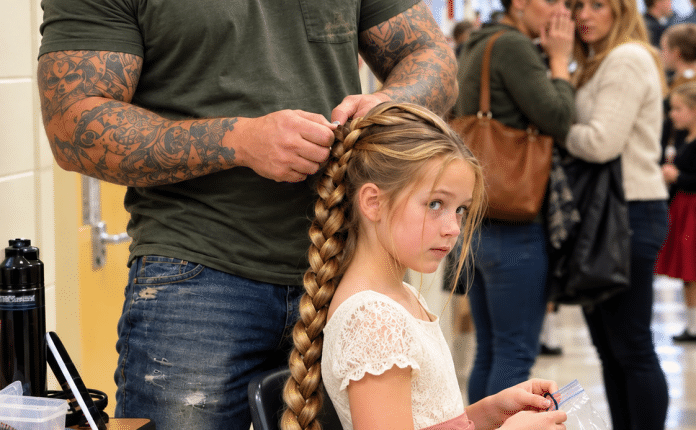
Dad called three days after our first real conversation, and for a moment I almost did not answer. Part of me expected his apology to have been temporary, something said during an uncomfortable evening that would disappear once everyone calmed down. Instead, he asked whether Maisie’s cold had improved. I had mentioned her stuffy nose only once, near the end of our previous call, and the fact that he remembered caught me off guard.
“She’s better,” I said. “Still offended every time I wipe her nose.”
Dad laughed. “She sounds like you at that age.”
Usually a comment like that would have led him into a story about me. This time he asked another question about Maisie instead. We talked for ten minutes. He did not mention Mom’s feelings, the property taxes, Kyle’s problems, or Brinn’s anger. When we hung up, I realized I had spent the entire call waiting for the hidden request that never came.
Mom’s apology arrived two days later by text. It was only four sentences. She said she had handled her birthday badly, admitted her message had been hurtful, and wrote that she should have called after I turned around. She ended by saying she hoped we could move forward before Christmas. Months earlier, I would have seized on those words as proof everything was repaired. Now I noticed what was missing.
I replied, “The problem wasn’t only that I drove home. The problem was that you talked about Maisie as though she were something everyone needed relief from.”
Mom did not answer for nearly an hour.
When her response finally appeared, it was shorter.
“You’re right.”
I read those two words several times. They were not enough to rebuild trust, but they mattered because she had not followed them with an excuse.
Brinn approached differently. A package arrived at my apartment containing a soft green sleeper covered in tiny white rabbits. Beneath it was a handwritten note. She admitted she had behaved badly after seeing the Montana photograph and wrote that messaging Lauren had been invasive and embarrassing. She called herself a lousy aunt. I appreciated that she had named something specific rather than sending a vague apology and expecting me to fill in the rest.
I sent her a picture of Maisie wearing the sleeper.
I did not write, Everything is fine.
It wasn’t.
Kyle waited longest. His name appeared on my phone one Sunday evening as a video-call request. When I answered, he immediately tried to joke that the family had apparently elected him the final defendant in “Jenna’s tribunal.” I stared at him without smiling. His grin faded almost at once.
“Okay,” he said. “That was stupid.”
“Yes.”
He rubbed his forehead. “I don’t know how to do this.”
“Try without making me the difficult one.”
That landed. Kyle looked away from the camera, then admitted he had been furious when he saw the Montana photograph because he assumed I had money I was withholding while everyone else struggled. Hearing himself say it seemed to embarrass him.
“You didn’t owe me anything,” he said. “I know that now.”
“You never should have thought I did.”
“I know.”
I believed that he understood the sentence intellectually. Whether he could live by it remained an open question.
A week before Christmas, Dad asked if he could come to Seattle on Christmas Eve. I immediately felt my shoulders tighten.
“Who’s coming with you?”
“Just me.”
“Dad, I’m serious. No surprise reunion.”
“I know.”
“And you can’t show up expecting me to invite everyone else because you drove three hours.”
“I’m not doing that.”
I agreed to an afternoon visit and spent the next several days wondering whether I had made a mistake.
Dad arrived ten minutes early carrying two grocery bags and a small gift sack. He stood outside my apartment until I opened the door rather than letting himself in the way he sometimes had before Maisie was born.
“I wasn’t sure what babies need,” he said, lifting the groceries slightly. “So I bought things adults need.”
I looked inside. Soup, fruit, bread, coffee, pasta, diapers, and three different kinds of baby wipes.
“You did pretty well.”
“I spent twenty minutes in the diaper aisle.”
“That explains the traumatized expression.”
For the first time in weeks, being around him felt almost easy.
Maisie was waking from her nap when we entered the living room. Dad heard her small complaining noises through the baby monitor and automatically took one step toward the bedroom. Then he stopped.
“Can I go see her?”
That question mattered more than he probably realized.
“Come with me.”
We found her kicking beneath the sleep sack, hair standing up in a ridiculous tuft. Dad smiled, but he stayed behind me until I lifted her. When I asked whether he wanted to hold her, nervousness crossed his face.
“If she’s okay with it.”
“She’s four months old, Dad. Her approval process is mostly drooling.”
His laugh came out shaky.
I transferred Maisie into his arms. His elbows went stiff as boards. He looked down at her with the concentration of someone carrying a priceless object across ice.
“You can breathe,” I told him.
“I am breathing.”
“Barely.”
Maisie stared at him, fascinated by his glasses. Then she grabbed the frame with surprising speed and nearly pulled it from his face.
Dad laughed so loudly that she startled, then smiled.
The change in his expression was immediate. His shoulders relaxed. He began talking to her quietly, introducing himself as though they had never met properly before.
Maybe they hadn’t.
“She’s beautiful,” he whispered.
A few minutes later his eyes became wet. He blinked quickly and looked at me.
“You’re doing a good job, Jenna.”
I almost brushed the compliment aside. I had spent months learning to survive without anyone telling me I was succeeding, and praise from Dad touched something raw.
“Thank you.”
“I should have told you that sooner.”
“Yes.”
He nodded.
There was no argument.
We ordered Chinese food because I refused to cook for a Christmas Eve visit that had already consumed enough emotional energy. Dad ate lo mein from a paper container at my kitchen table while asking about feeding times, naps, pediatric appointments, and which songs settled Maisie when she became overtired.
He listened carefully enough that I eventually noticed what he was doing.
“You’re studying.”
“I missed three months,” he said. “I have catching up to do.”
The words hurt and comforted me at once.
After dinner, I decided not to let the pleasant afternoon postpone the conversation we still needed.
“Dad, I need something to be clear.”
He put down his fork.
“I’m listening.”
“Money is different now. Completely different.”
His expression tightened, but he did not interrupt.
“I’m not the family emergency account anymore. If someone has a problem, they don’t hint until I offer. They don’t tell me how worried they are and wait for me to transfer money. Mom already brought up the property taxes once. I’m not paying them.”
Dad looked down at the table.
“Understood.”
“I mean it.”
“I know.”
“If Kyle gets into trouble, I’m not automatically fixing it. If Brinn wants something she can’t afford, it isn’t mine to cover. If you and Mom have an unexpected expense, you figure it out before looking at me.”
Dad rubbed his thumb along the edge of the container.
“We got used to you stepping in.”
“That doesn’t make it fair.”
“No.”
He looked at me.
“I don’t think we sat around deciding to use you, Jenna.”
“I don’t think you did either.”
That surprised him.
I continued, “But people can take advantage of someone without planning it. You all learned that if you were stressed loudly enough, I would solve things. And I learned that solving things made me feel secure in the family.”
Dad absorbed that without defending anyone.
“That’s not going to happen anymore,” I said.
“Okay.”
He left shortly after Maisie’s evening bottle. At the door, he hugged me without squeezing too tightly and kissed the top of my daughter’s head only after looking at me for permission.
“Merry Christmas, kiddo.”
“You too, Dad.”
He reached the hallway, then turned.
“I’m sorry I waited until you stopped helping us to notice how much you needed help.”
I had no clever response.
“Drive safely.”
That was all I could manage.
Christmas morning began at five-thirty because Maisie had no respect for holidays. I had just settled her on my bed when Mom called.
Seeing her name made my stomach tighten.
I answered anyway.
“Merry Christmas,” she said.
Her voice sounded quieter than usual.
“Merry Christmas.”
For several seconds neither of us knew what to say. Then Mom told me Dad had come home talking about Maisie and showing her the photographs he had taken. She said she was glad the visit had gone well.
I waited.
Then, finally, she said, “I need to apologize properly.”
I sat against the headboard.
“Okay.”
Mom admitted that after Derek left, she had become preoccupied with everything she thought my life would now require. Childcare. Money. Time. Dependence. She worried I would need more from the family than they could comfortably give, and instead of admitting that fear, she had become critical.
“When Maisie was born,” she said, “everything became real.”
“She was always real to me.”
“I know.”
“Do you?”
Mom became quiet.
“I do now.”
She said the birthday gathering had felt like something she wanted to control. She imagined crying, bottles, interrupted dinner, and everyone adjusting around a baby. So rather than accept that grandchildren changed family gatherings, she decided the easiest solution was to ask me not to bring the reason things had changed.
“You didn’t ask me not to bring her,” I said. “You told both of us not to come.”
“I know.”
“And then you called her ‘your kid’ like she was a stranger.”
Her breath caught slightly.
“I know.”
I looked at Maisie asleep beside my leg.
“She isn’t background noise, Mom. She isn’t a problem attached to me. She’s your granddaughter.”
“You’re right.”
“And being sorry doesn’t mean you suddenly get unlimited access to her.”
“I understand.”
“I need you to prove that.”
“I want the chance.”
We ended the call without saying everything was fixed.
That felt healthier than pretending.
A few days later, Dad asked whether I would consider letting everyone visit on New Year’s Day. My instinct was no. Then I thought about what I actually wanted. I did not want lifelong punishment. I wanted different behavior.
So I set conditions.
No guilt if I ended the visit early. No arguing about my parenting. No money discussions. Nobody would treat Maisie like a photo opportunity and then disappear when she cried.
Dad responded with one word.
“Agreed.”
They arrived carrying groceries instead of expectations.
Mom stood near the door until I hugged her first. Brinn brought lunch and immediately began setting plates on the table rather than handing me another job. Kyle had apparently noticed from one of my pictures that a cabinet hinge was broken, so he brought tools and fixed it without announcing that he was doing me a huge favor.
The most surprising moment came when Mom approached Maisie.
“May I?”
She actually asked.
I handed my daughter over.
Mom held her carefully. Maisie stared up at her face, then gave one of those enormous open-mouthed baby smiles that arrived without warning.
Mom’s eyes filled instantly.
“Oh,” she whispered.
She turned away as though embarrassed by the tears.
Nobody teased her.
Later, while Dad and Kyle cleaned the kitchen, Brinn sat beside me on the sofa.
“I was jealous,” she said.
I looked at her.
“Of Montana?”
“Not exactly.”
She picked at a loose thread on her sleeve.
“I saw you somewhere beautiful with people who looked happy to have you there. And instead of thinking we messed up, I thought you were showing off.”
“At first you thought I’d paid for it.”
“I wanted that to be true.”
“Why?”
“Because then I could be mad at you instead of embarrassed about us.”
The honesty startled me.
Across the room, Kyle had apparently heard enough of the conversation to understand what was happening.
“I did the same thing,” he said.
He leaned against the kitchen doorway.
“I saw money. That’s what I saw first.”
He looked uncomfortable but continued.
“You gave me three thousand dollars when nobody else would. After that, I guess some part of me started thinking you’d always rescue me.”
“I won’t.”
“I know.”
“No, Kyle. Really. If your next business idea crashes, I’m not funding the one after it.”
He smiled weakly.
“Fair.”
Mom had been quiet.
Then she spoke.
“I think all of us assumed Jenna would always come back.”
The room went still.
Mom looked directly at me.
“You always did. Even when we were unfair. Even when someone said something hurtful. You were the one who called first, apologized first, offered help first.”
There it was.
The thing none of us had ever said aloud.
I had made abandoning my own boundaries look so dependable that everyone eventually mistook it for my personality.
“I’m not doing that anymore.”
Mom nodded.
“I know.”
New Year’s Day ended without a dramatic group hug or promises that everything would be perfect. I did not want either. Dad took out the trash before leaving. Brinn washed bottles. Kyle tightened the loose handle on my bedroom door after finishing the cabinet.
Mom kissed Maisie’s forehead and handed her back when she began fussing.
At the doorway, she asked whether she could call later in the week.
“You can ask,” I said.
A tiny smile crossed her face.
“Fair enough.”
After they left, I sat in the quiet living room with Maisie asleep against my chest and looked through the photographs from the afternoon.
We did not look like the family we had been before.
I was grateful for that.
The old version had depended on me swallowing hurt faster than anyone had to acknowledge causing it.
Whatever came next would need to survive without that arrangement.
Apologies had been the easy part.
Sooner or later, somebody would have a problem that money could solve.
When that happened, I would discover whether my family had actually changed—or whether they were simply behaving well until they needed the old Jenna again.