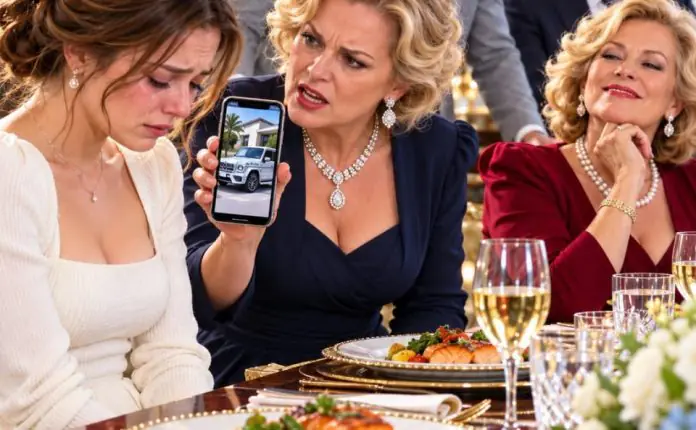
Chapter 1 — You Deserved It
“If my parents hit you, there must have been a good reason.
You know how they are.

You provoked them by refusing to hand over the money.”
Those were the first words my husband said to me when he walked into my hospital room.
Not how are you feeling. Not I’m so sorry. He sat down in the visitor’s chair beside my bed and looked at me as though I were an inconvenient household problem he had come to sort out.
I will not describe, in this story, exactly what had put me in that hospital bed the night before.
I lived through it once, and that was enough, and the people who did it do not deserve to have their violence retold in loving detail for anyone’s entertainment.
It is enough to say that the night before, my husband’s parents had beaten me badly enough that a neighbor called an ambulance, and that I woke in a hospital, and that the first human being from my own family to arrive at my side had come not to comfort me but to finish the job his parents had started, with words instead of hands.
We had been married for ten years.
And in the space of that single sentence — there must have been a good reason — the whole architecture of those ten years, which I had spent a decade calling love, showed me, at last, what it had actually been.
I said nothing to Bruno.
But from that hospital bed, with my left eye swollen shut and my whole body one deep ache, I had already begun, in silence, to do the thing that would end all of them.
I had begun to plan.
Chapter 2 — Ten Years
Ten years.
That is how long I endured his family before the night everything broke.
Ten years of his mother, Amber, making cutting remarks about my clothes, my accounting career, the way I served dinner.
Ten years of his father, Indigo, preaching, in his patient and reasonable voice, that a good daughter-in-law helps her family without ever keeping tabs on what she gives.
And ten years of quietly handing over a large portion of my salary, month after month, to maintain a house in a gated suburb that his parents bragged about, to anyone who would listen, as their own family legacy — a legacy I paid for and was permitted to dust.
I want to be honest that for most of those ten years, I did not experience myself as an abused woman.
I experienced myself as a loyal one.
That is the thing about the slow kind of cruelty: it never announces itself.
There was no single day I could point to and say, that is the day it became unbearable, because each demand was just slightly larger than the last, each insult just slightly sharper, and I had been raised to believe that a strong woman endures, keeps the peace, sacrifices for her family without complaint.
So I endured.
I kept the peace.
I sacrificed.
And I called all of it love, and I called my own steady erasure strength, until the night my in-laws taught me, with their hands, the difference between the two.
I want to explain, as carefully as I can, how a capable and intelligent woman ends up in a situation like mine, because when people hear a story like this, their first, unspoken question is always the same: why did she stay so long?
Why didn’t she see it?
And I understand the question, because I would have asked it too, once, of a woman like me.
The answer is that abuse of the slow kind does not arrive as abuse.
It arrives as love, and as family, and as reasonable requests, and it escalates so gradually that there is never a clear line to refuse at.
If, on our very first day, Bruno’s family had demanded my grandmother’s inheritance and beaten me for refusing, I would have walked out that night and never returned; anyone would have.
But that is not how it happened, because that is never how it happens.
It began with a mother-in-law’s opinions about my cooking, which seemed petty to make a fuss over.
It proceeded to a father-in-law’s gentle sermons about family generosity, which seemed ungracious to resist.
It moved to helping with the mortgage, which seemed loving to offer.
Each individual step was small enough that refusing it would have felt like an overreaction, like I was the difficult one, the cold one, the one making problems out of nothing — and that feeling, that I would be unreasonable to object, was itself the mechanism, applied a thousand times over a decade.
You do not stay because you are foolish.
You stay because you are decent, and because decent people give the benefit of the doubt, and extend grace, and assume good faith, and will not walk out over small things — and abusers of this kind survive entirely by keeping every individual demand just small enough to make walking out feel like the unreasonable response.
The trap is built out of your own good qualities.
Your patience, your loyalty, your willingness to sacrifice, your reluctance to make a scene: these are not the flaws that keep you trapped.
They are virtues, turned into a cage by people who knew how to exploit them.
I did not stay for ten years because I was weak or blind.
I stayed because I was loyal and patient and kind, and those were exactly the tools they used to build the walls.
Understanding that let me forgive the woman I had been.
She was not a fool.
She was a good person, in the hands of people who knew precisely how to turn her goodness into a weapon.
And the day I understood that, I stopped being ashamed of her, and started, simply, being free of them.
Chapter 3 — Permission to Save Yourself
The thing that finally cracked the ten years open was money, as it so often is — specifically, my grandmother’s money.
My grandmother had died three months earlier, and she had left me an investment portfolio worth three point eight million dollars, the fruit of an entire lifetime of careful, patient, unglamorous saving.
She had been a woman who understood, from her own hard life, exactly what money is for.
And before she passed, she held my hand in both of hers, and she said something to me that I did not fully understand until months later, in a hospital bed.
“Jade,” she said.
“This is so that you never have to ask anyone for permission to save yourself.”
I thought, at the time, that she meant something ordinary about financial security, a comfortable retirement, a cushion.
I know now that she meant something far more specific, and wiser, because my grandmother had lived long enough to have watched women she loved be trapped by their own dependence, unable to leave the people hurting them because they had no money of their own and nowhere to go.
She was not leaving me a cushion.
She was leaving me a door — an exit, a way out, the one thing that could not be argued or endured or sacrificed away.
She was leaving me the ability to save myself without asking anyone’s permission.
My in-laws looked at that inheritance and saw three million dollars they intended to take.
They never understood what it actually was.
It was the key my grandmother had pressed into my hand, from beyond her own grave, to the cage they had spent ten years building around me.
I have come to believe that my grandmother understood something about money that almost no one says out loud, because it is unromantic, and because we prefer to believe that love, not money, is what keeps people safe.
But my grandmother had lived through a harder and more honest century than mine, and she knew the truth: that for a woman in a bad situation, financial independence is not a luxury or a comfort.
It is very often the literal difference between escaping and dying.
She had watched, across her long life, women she loved remain in homes that were destroying them — not because they lacked courage, and not because they did not understand what was happening to them, but because they had no money of their own, and nowhere to go, and no way to feed their children if they left, and so the door was locked not from the outside but by their own dependence.
A woman with no independent resources is not free to leave, no matter how brave she is, because leaving would mean choosing homelessness and hunger over abuse, and that is not a real choice at all.
It is a trap dressed as an option.
My grandmother knew this in her bones, and when she left me that inheritance, she was not leaving me spending money.
She was leaving me the one thing that transforms leaving from an impossible fantasy into an actual, executable decision: the means to survive on the other side of the door.
That is what she meant by permission to save yourself. Not permission from anyone else — the money was permission from reality itself, the material fact that made freedom physically possible.
A person can only walk out a door they can survive walking through.
My grandmother spent her whole life saving so that her granddaughter would never stand at a door she could not afford to open.
And when the day came that I had to open it, I could, because she had made sure of it, decades in advance, one careful dollar at a time.
Chapter 4 — I Said No
On the night everything exploded, Amber and Indigo were waiting in my living room when I got home from work.
Indigo slapped a stack of glossy flyers onto the coffee table — a questionable real-estate development, the kind of scheme that promises everything and delivers nothing — and announced that they needed three million dollars from me to enter as founding partners.
Not asked — announced.
As though my grandmother’s life savings were simply a family resource they had decided how to spend.
I said no.
I will keep the rest of that night brief, for the reasons I have already given.
The refusal was met first with insults, and then, when the insults did not move me, with violence.
I ended up on the floor of my own dining room, with my arms wrapped around my own body, trying to make myself small.
I remember Amber leaning down close to my ear and telling me, quietly, that I would not be leaving that house until I signed the papers.
And then I remember nothing, until the hospital.
A neighbor had heard the screaming and called for help.
I have thought often about that neighbor, a person whose name I still do not know, and about how a stranger’s single phone call did what ten years of my own endurance never could: it got me out of that house alive.
I would spend the following year learning that lesson in a hundred forms.
Endurance had never once saved me.
Every time I was actually saved, it was because someone acted.
That is the single most important thing I learned from the whole ordeal, and it overturned a belief I had been raised inside so completely that I had never once thought to question it.