
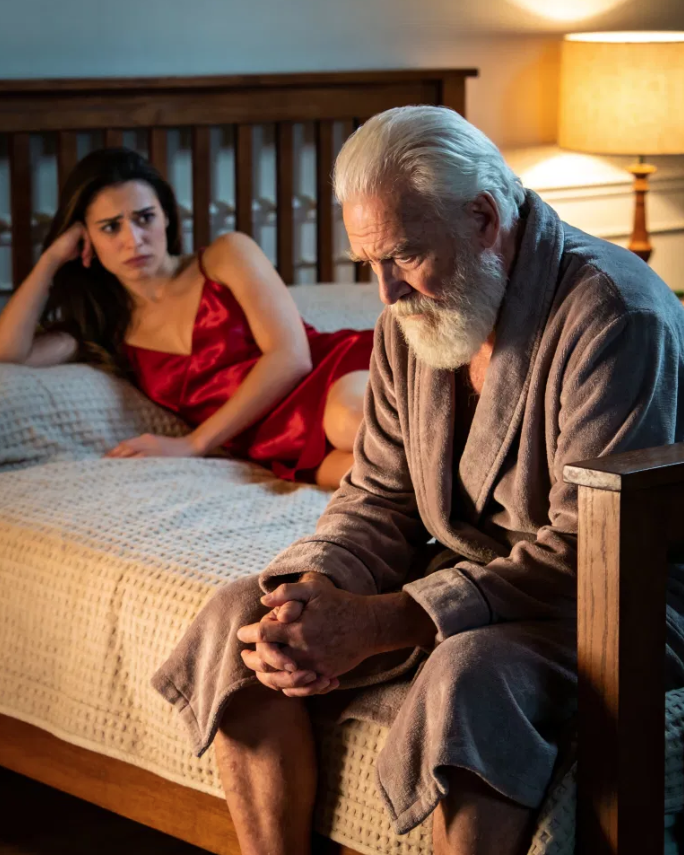
I married a wealthy old man to save my family… but on our wedding night, he didn’t touch me. He simply sat in the darkness and said: “Sleep. I want to watch.” The way he said it made my skin crawl… and by morning I realized this marriage had never been about money.
I married a man whose wealth could silence hospitals, erase debts, and buy entire years of life for someone else. I did not marry him for love, and he never pretended that I did. The contract was clear even if the emotions were not. My father needed treatment that our family could not afford, and this man offered a solution without asking for affection in return. What I did not expect was the way my first night as his wife would unfold, or how deeply that night would shape everything that followed.
My name is Lillian Moorefield, and the first thing my husband said to me after the wedding guests left was spoken from the shadows.
“You should sleep now,” he said calmly. “I will remain here.”
His voice carried no warmth, no threat, yet it unsettled me more than anger ever could. I sat frozen on the edge of the bed, still wearing the ivory dress I had chosen more for modesty than beauty. My hands trembled against the fabric, and my heart pounded so loudly that I feared he could hear it.
I asked him if he planned to join me.
“No,” he answered. “I only need to watch.”
The lamp beside the bed was turned off. The room was dark except for the faint glow from the city beyond the window. I saw him take a wooden chair and place it near the wall, facing the bed. He sat down slowly and folded his hands as if preparing for a long vigil.
I did not understand him. I wondered if he was unwell, or cruel in a quiet way, or bound by some private ritual I had never been warned about. Exhaustion eventually pulled me under, and when I woke the next morning, the chair was empty and my husband was gone.
The second night unfolded the same way. So did the third.
The staff in the house avoided my eyes. Meals appeared without comment. Doors closed softly behind me. It was as if everyone knew something I did not and had agreed never to speak of it.
On the fourth night, fear became something physical.
I woke to the sound of breathing close to my ear. It was slow and unsteady. I opened my eyes and saw him standing beside the bed, so near that I could smell the faint trace of aged cologne clinging to his shirt. His eyes were wide, focused not on my face but on my eyelids, as if he were watching for something beneath them.
When I gasped, he stepped back instantly, as though caught doing something forbidden.
“I did not mean to wake you,” he said quietly.
I sat up, clutching the sheets.
“What do you want from me?” I asked, my voice barely steady.
He looked down at the floor.
“Sleep,” he replied. “That is all.”
The following day, I confronted him in the study. He stood by the window, staring out at the tall oaks lining the driveway.
“Are you afraid of me?” I asked.
His silence was heavier than any answer.
That night, I pretended to sleep. I kept my eyes closed and my thoughts alert. He placed the chair beside the bed, closer than before, and sat on the floor with his back against it, as if guarding something fragile.
After a long while, he spoke.
“Yes,” he said.
“Yes what?” I asked softly.
“I am afraid,” he admitted. “But not of you. Of what might happen when you are asleep.”
The truth came in fragments after that. His first wife had died years earlier. Officially, her death was labeled as sudden cardiac failure. He never believed it. He told me she had wandered at night, eyes open yet unseeing, moving as if guided by something else.
“One night I slept,” he said. “Only once.”
His voice broke.
“When I woke, she was gone.”
The house, he explained, became a fortress after that. Locks. Alarms. Bells on doors. Precautions layered upon precautions. Fear had shaped every wall.
I wanted to deny his story, but then something happened that made denial impossible.
One morning, a housekeeper told me she had found me standing at the top of the staircase in the middle of the night, unmoving, eyes wide open. My husband had been holding me, soaked in sweat, keeping me from stepping forward.
“Do you see now?” he asked me later, desperation raw in his voice.
I was terrified, not only of him, but of myself.
Yet fear did not break us. Instead, it became routine. Routine turned into something resembling safety.
One night, during a power outage, I reached for his hand in the dark. He did not pull away.
“If I am scared,” I whispered, “will you stay awake?”
“I will,” he answered without hesitation.
Months later, he collapsed.
The hospital corridors smelled of disinfectant and dread. Machines hummed around him as he lay unconscious, suddenly frail and older than I had ever allowed myself to see.
A doctor pulled me aside.
“What is your relation to the patient?” he asked.
In that pause, I realized how real this marriage had become.
“I am his wife,” I said firmly.
An elderly nurse later showed me records. The first wife had not died in bed. She had fallen from the roof during a sleepwalking episode. She had survived several similar incidents before, each time because someone had been awake to stop her.
“He was not controlling her,” the nurse said gently. “He was guarding her.”
When my husband recovered enough to come home, he no longer sat in the chair. He slept near the door instead, farther from the bed.
“You do not need watching anymore,” he told me.
But I watched him. His illness worsened. Fever dreams haunted him. I held his hand when he whispered nonsense and begged shadows not to leave.
Eventually, the truth of my condition emerged. A specialist explained that my sleepwalking was tied to trauma from childhood, buried until stress awakened it. My husband had recognized the signs long before I did.
“Why did you not tell me?” I asked him.
“Because you would have fled,” he answered quietly.
When his health failed again, he urged me to leave, to take my father and start over. That night, when he finally slept, I sat in the same chair he once used and watched him breathe.
He smiled in his sleep.
The danger had never been me.
After a risky surgery, he survived. We sold the house. We moved to a small town where no one knew our names. No alarms. No guards. Just one bed and two people learning to rest at the same time.
Years later, when he passed peacefully in his sleep, I sat beside him and watched until the end. There was no fear left. Only gratitude. Sometimes, the man who seems the strangest is the one who stays awake so others can rest.