At Thanksgiving Dinner, My Brother Smirked, “Let’s See If She’s Really Allergic,” And Handed Me Crab Soup. My Aunt Laughed, “It’s Just A Joke.” The Table Laughed Like It Was Harmless. I Didn’t Touch It. Seconds Later, The Laughter Vanished—Everyone Started Screaming.
### Part 1
My brother leaned back in his chair with that familiar little smirk I had hated since childhood, looked across our crowded Thanksgiving table, and said, “Let’s see if she’s really allergic.”
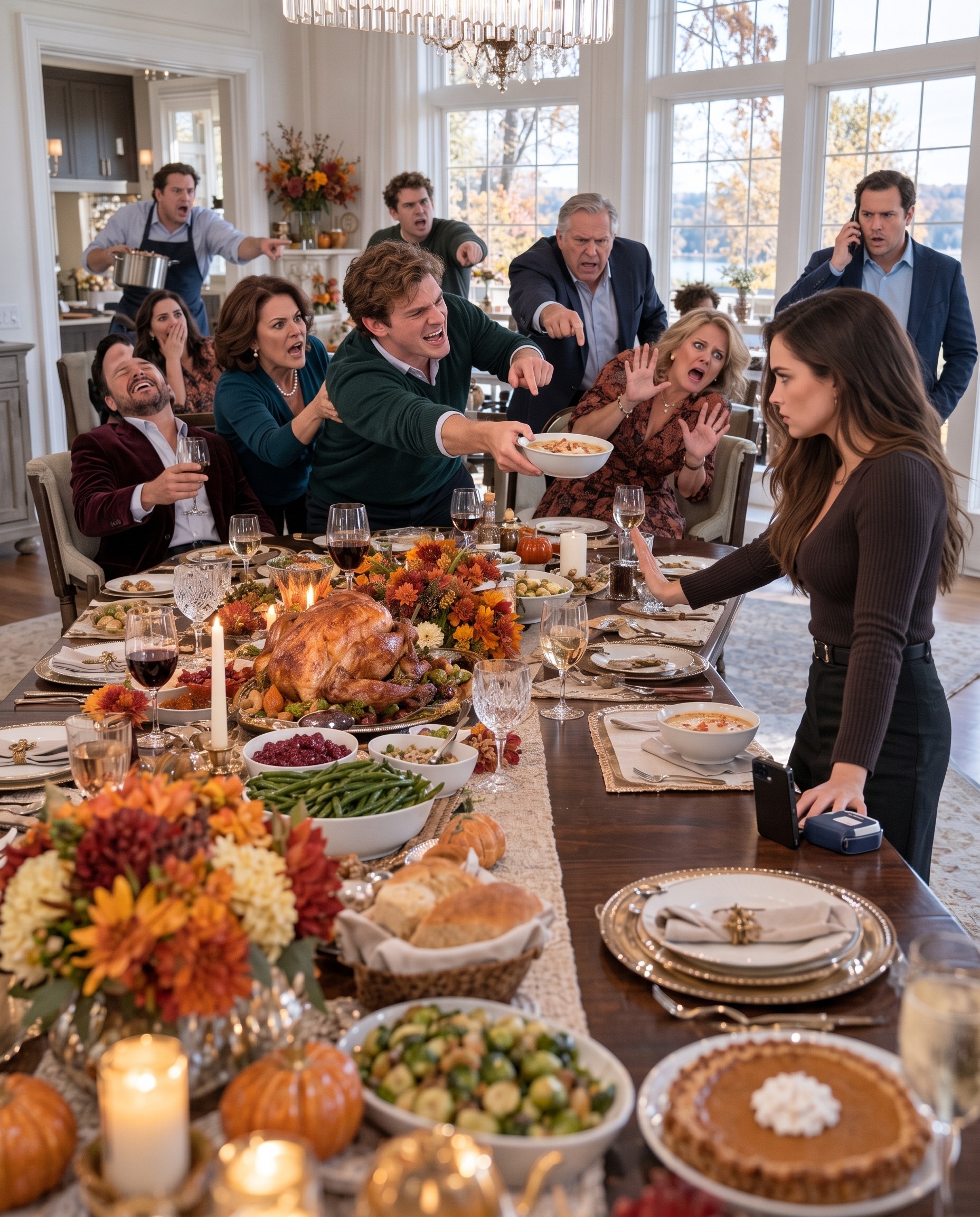
Then he pushed a steaming bowl of crab soup toward me.
The bowl stopped six inches from my plate. I could smell the salt and butter rising with the steam, mixed with roasted turkey, sage stuffing, cinnamon candles, and the faint pine scent from the wreath my mother had hung over the dining room mirror. Twelve members of my family were sitting around the table, and for one strange second, nobody moved.
Then my aunt Denise laughed.
“Oh, relax, Maya. It’s a joke.”
My brother Trevor laughed too. His girlfriend, Paige, covered her mouth as though she were trying not to. My father gave the embarrassed little chuckle he always used when Trevor crossed a line but Dad didn’t want to admit it, and my mother looked at me with the warning expression I had known since elementary school.
Don’t make this a problem.
That expression had shaped half my life.
I was twenty-six years old, a graphic designer for my parents’ real-estate company, and I had a severe shellfish allergy. Not an upset stomach. Not a rash that disappeared after an hour. A real allergy, the kind that meant I checked restaurant kitchens before ordering and carried emergency medication everywhere I went.
My family knew.
They had always known.
When I was eight, a restaurant mix-up sent me to the emergency room. When I was thirteen, I spent Christmas dinner eating crackers in my bedroom because Aunt Denise insisted everyone should be allowed to enjoy her shrimp platter. At seventeen, Trevor waved a piece of seafood near my face at a graduation party because he thought watching me panic was hilarious.
Every time, the family response was the same.
“Trevor’s kidding.”
“Denise didn’t mean anything.”
“You’re too sensitive.”
“You’re making everyone uncomfortable.”
Some families pass down jewelry. Mine passed down excuses.
I looked at the bowl sitting near my plate and slowly pushed my chair backward.
Trevor grinned wider.
“See?” he said. “She won’t even sit near it.”
“Because I don’t want to spend Thanksgiving in an ambulance.”
“Oh, come on.”
“I’m serious.”
“So am I.” He lifted the bowl and held it up like some ridiculous trophy. “You’ve spent your entire life making everybody adjust everything around you. Separate pans. Separate utensils. Separate food. Maybe we’re finally tired of pretending.”
The sentence landed harder than I expected.
Not because it was new.
Because he said “we.”
I looked toward my parents.
My father suddenly became fascinated by his mashed potatoes.
My mother folded her napkin and said, “Maya, nobody is saying your allergy isn’t real.”
Trevor laughed.
“That’s exactly what I’m saying.”
My aunt snorted into her wine.
I felt heat crawl up my neck, but I forced my voice to remain steady. “Then why did I spend three days cooking almost this entire meal?”
That part bothered me most.
Thanksgiving was being held at my parents’ house, the brick colonial where Trevor and I had grown up. My mother had undergone knee surgery six weeks earlier and couldn’t stand comfortably for long periods, so I had volunteered to handle nearly everything. I cleaned the kitchen, ordered groceries, made the turkey, stuffing, potatoes, vegetables, pies, and two appetizers. I had even labeled several serving utensils because relatives were bringing their own dishes.
I wasn’t demanding anyone cater to me.
I had done the catering.
Trevor had arrived barely thirty minutes before dinner wearing a charcoal sweater, expensive boots, and the confidence of a man who had never once been required to wonder whether people would forgive him.
He carried one insulated bag.
Paige carried another.
When I asked what was inside, Trevor said, “Don’t worry about it.”
I should have worried.
Aunt Denise arrived behind them, kissed Trevor on both cheeks, and walked into the kitchen without even saying hello to me.
At the time, I noticed it.
I simply didn’t understand it.
Now I watched the three of them exchange tiny glances across the table.
Trevor.
Paige.
Denise.
There was something underneath the joke.
Something rehearsed.
“Where did that soup come from?” I asked.
Trevor shrugged. “Bought it.”
“Why?”
“Because some people like seafood.”
“You’ve never served crab soup at Thanksgiving in your life.”
“Maybe I’m expanding my horizons.”
Denise sighed dramatically. “Good grief, Maya. Not everything is about you.”
I looked at her.
She wouldn’t meet my eyes.
That was when the first cold thread of suspicion slid down my spine.
Two weeks earlier, Denise had appeared unexpectedly in the marketing department at my parents’ office, where I worked three days a week and remotely for the rest. She had supposedly come to bring my father paperwork, but she spent nearly twenty minutes asking me strangely specific questions.
Was my allergy still severe?
Had I ever been retested?
Did reactions become less serious as people got older?
Did I really need to carry emergency medication everywhere?
I had assumed she was being nosy.
Denise was always nosy.
Now I remembered something else.
Three days after that conversation, Trevor had cornered me near the office printer.
“Our employee health costs are ridiculous,” he’d said.
I hadn’t understood why he was telling me.
Trevor ran sales for our parents’ company. I designed listings, advertising campaigns, brochures, and client presentations. We had little reason to discuss benefits.
“Okay,” I had answered.
He stared at me.
Then he said, “Some people cost the company more than others.”
I asked whether he was talking about me.
He smiled.
“I didn’t say that.”
At the Thanksgiving table, that same smile was back.
I felt suddenly foolish for not connecting the conversations sooner.
Trevor lowered the soup bowl, but instead of setting it down, he dipped a spoon into it.
“Watch this,” he said.
Paige stopped smiling.
It happened so quickly that I nearly missed it.
“Trevor,” she murmured.
He looked at her. “What?”
“Nothing.”
There was fear in her expression.
Not concern about me.
Concern about him.
Trevor scooped up a spoonful of crab soup and held it toward me.
“Last chance. One taste.”
“No.”
“Then I’ll prove how ridiculous you’re being.”
He swallowed the spoonful himself.
Aunt Denise burst out laughing.
“There. Brave man!”
Trevor set the spoon down and reached for his turkey.
“See?” he said. “Absolutely nothing happened.”
I stared at Paige.
She was watching Trevor strangely.
Her fingers had tightened around her napkin.
“What?” I asked.
She shook her head.
Trevor cut a large piece of turkey, dragged it through gravy, and brought the fork to his mouth.
He chewed.
Smiled.
Started to say something.
Then stopped.
His fork slipped from his fingers.
The metal struck the edge of his plate with a sharp clang before bouncing onto the hardwood floor.
Every conversation died.
Trevor lifted one hand toward his throat.
His eyes widened.
“Trevor?” my mother said.
He tried to answer.
Nothing came out.
The confidence vanished from his face so completely that for half a second I barely recognized my brother.
He stood too quickly, knocked his chair backward, and grabbed the edge of the table.
Paige screamed.
My mother shot to her feet.
Denise’s wineglass slipped from her hand and shattered against a serving platter, splashing red wine across the white tablecloth.
Trevor’s breathing had changed.
I knew that sound.
I had heard it coming from my own body.
“Call emergency services,” I shouted.
Nobody moved.
“Now!”
My father finally grabbed his phone.
Trevor staggered.
And while the same people who had laughed at my allergy less than a minute earlier began screaming his name, I ran for the purse they had spent years mocking me for carrying everywhere.
Because suddenly, the only person at that Thanksgiving table who knew what to do was me.
And as I reached for my emergency injector, one terrible question went through my mind.
Trevor had eaten shellfish his entire life.
So why was he reacting now?
### Part 2
Chaos has a sound.
It isn’t screaming, exactly. It is twenty unrelated sounds happening at once—the scrape of chairs, breaking glass, somebody crying, somebody demanding towels, my father’s voice shaking while he gave our address over the phone, and my mother repeating Trevor’s name as though saying it enough times could somehow keep him conscious.
I didn’t think about any of it.
I had spent almost two decades learning how to respond to the kind of emergency my family insisted I exaggerated, and now muscle memory took over.
I used my emergency injector on Trevor and told my father to unlock the front door for the paramedics. Paige stood against the wall with both hands over her mouth, crying so hard she could barely speak. Aunt Denise kept asking whether Trevor had choked on something.
“No,” I said sharply. “This looks like a severe allergic reaction.”
Denise stared at me.
“To what?”
“I don’t know.”
That answer seemed to frighten Paige more than anybody else.
Her face went almost gray.
I saw it.
“Paige.”
She shook her head.
“What?”
“Has Trevor had reactions before?”
“No.”
The answer came too quickly.
“Paige.”
“I said no.”
Trevor began getting some air again, though he was still struggling. I knelt beside him, kept him as still as possible, and waited for the sirens.
When they finally came, the sound was strangely comforting.
Two paramedics entered carrying equipment, followed by another emergency responder. They took over immediately, asking what Trevor had eaten, whether he had known allergies, what medication I had administered, whether he had consumed anything unusual.
“Crab soup,” my mother said.
One of the paramedics looked toward Trevor. “Shellfish allergy?”
“No,” Paige answered.
Then she whispered, “Not that we knew of.”
That phrase caught my attention.
Not that we knew of.
The paramedics loaded Trevor onto a stretcher. My parents followed them outside, and Aunt Denise rushed after them wearing one shoe because the other had apparently come off somewhere beneath the table.
Within minutes, the dining room was nearly empty.
The turkey sat carved and cooling beneath the chandelier.
Mashed potatoes had spilled onto the tablecloth.
Denise’s broken wineglass glittered beside a bowl of cranberry sauce.
One of the candles had gone out.
It looked like a photograph of a family celebration interrupted by a bomb.
I stood there breathing slowly, trying to understand what had happened.
Then I heard Paige behind me.
“Oh, God.”
I turned.
She wasn’t looking at the door.
She was looking at Trevor’s phone.
It had fallen beside his overturned chair.
The screen was lit.
Paige moved toward it.
I got there first.
“Give me that,” she said.
“Why?”
“It’s Trevor’s.”
“So?”
“Maya, give it to me.”
The panic in her voice was completely different from what I had heard during Trevor’s reaction.
This wasn’t fear for him.
This was fear of something else.
The phone screen showed several new notifications.
One was from Aunt Denise.
Another was from a group conversation with Denise and Paige.
The preview was short.
Did she eat any yet?
My stomach dropped.
I looked at Paige.
Her mouth opened.
Nothing came out.
“What is that?”
“It’s nothing.”
“Why is Denise asking whether I ate something?”
“Maya.”
“What did you do?”
She lunged for the phone.
I stepped backward.
“Don’t.”
“I need to call the hospital.”
“Use mine.”
Her entire expression changed.
The crying disappeared.
“Maya, you don’t understand.”
“Then explain it.”
She looked toward the front windows, where red emergency lights still flickered across the glass.
“I can’t.”
That was answer enough.
Trevor had left the phone unlocked after using it shortly before dinner, and the group conversation was still open beneath the notification screen. I didn’t need to search through months of private messages. The most recent exchange was sitting there.
And after reading the first three lines, I forgot how to breathe.
Trevor: She’ll never touch anything if she knows there’s seafood here.
Denise: Then don’t tell her.
Paige: This is getting stupid.
Trevor: It’s already handled.
I scrolled.
The messages went back several days.
At first they were vague jokes about me.
Princess Maya.
Emergency-room royalty.
The family insurance mascot.
Then the tone changed.
Trevor complained that our parents’ small company was spending too much on employee benefits. He claimed that once Dad retired, Trevor would have to “clean up the payroll.” Denise encouraged him.
I kept reading.
The plan slowly became clear.
Trevor wanted to convince our parents that I had exaggerated my allergy for years because he believed that would make it easier to push me out of the company.
That alone was absurd.
But he wasn’t satisfied with simply confronting me.
He wanted a demonstration.
A Thanksgiving performance.
Something that would embarrass me in front of relatives.
Something that would make my parents believe him instead of me.
The messages never described every detail, but they said enough.
They had been planning to deliberately expose my food to something they knew could make me sick.
Not enough, Trevor kept insisting, to create “real trouble.”
Just enough to prove I was pretending.
My hands started shaking.
I looked around the kitchen.
Suddenly every harmless detail became threatening.
The serving spoons.
The plates.
The cutting boards.
The containers Trevor and Paige had carried inside.
I thought about how often Denise had wandered through the kitchen that afternoon.
I thought about Trevor asking whether I needed help while I was upstairs changing clothes.
I thought about Paige quietly saying, “Maybe this isn’t a good idea,” and Trevor answering, “Stop being dramatic.”
At the time, I assumed they were discussing something personal.
They had been discussing me.
“You knew?” I whispered.
Paige’s eyes filled again.
“I told him not to.”
“But you knew.”
“He said nothing would happen.”
“You knew.”
“He said he just wanted your parents to see you were exaggerating.”
I laughed once.
It didn’t sound like laughter.
“My parents?”
Paige hesitated.
“What?”
She looked away.
“Your dad knew Trevor wanted you off the company plan.”
I stared at her.
“What did you say?”
“Not this. Your dad didn’t know about this.”
“But he knew Trevor was trying to get rid of me?”
“He knew Trevor thought your benefits were costing too much.”
The room seemed to tilt.
I sat down.
For years, my family had treated my allergy as though it were a personality defect. I could survive that. I had survived it.
But this was different.
Someone had looked at a medical condition capable of killing me and decided it would make a useful family experiment.
“Why did Trevor react?” I asked.
Paige wiped her face.
“I don’t know.”
“You were scared before he ate the soup.”
She didn’t answer.
“Paige.”
Still nothing.
I stepped toward her.
“What aren’t you telling me?”
Her shoulders collapsed.
“About nine months ago,” she whispered, “Trevor had a reaction after eating shrimp.”
I froze.
“He what?”