My SIL Threw Water on Me and Accused Me of Stealing $13K—Then the Police Arrived
My name is Naomi Hart. I was twenty-nine years old when my sister-in-law threw a glass of ice water across my father’s retirement dinner and accused me of stealing a wallet she claimed contained $13,000.
My mother told me to leave. My father would not look at me. My brother, Caleb, stood beside his wife and said, “Just go, Naomi. Don’t make this worse.”
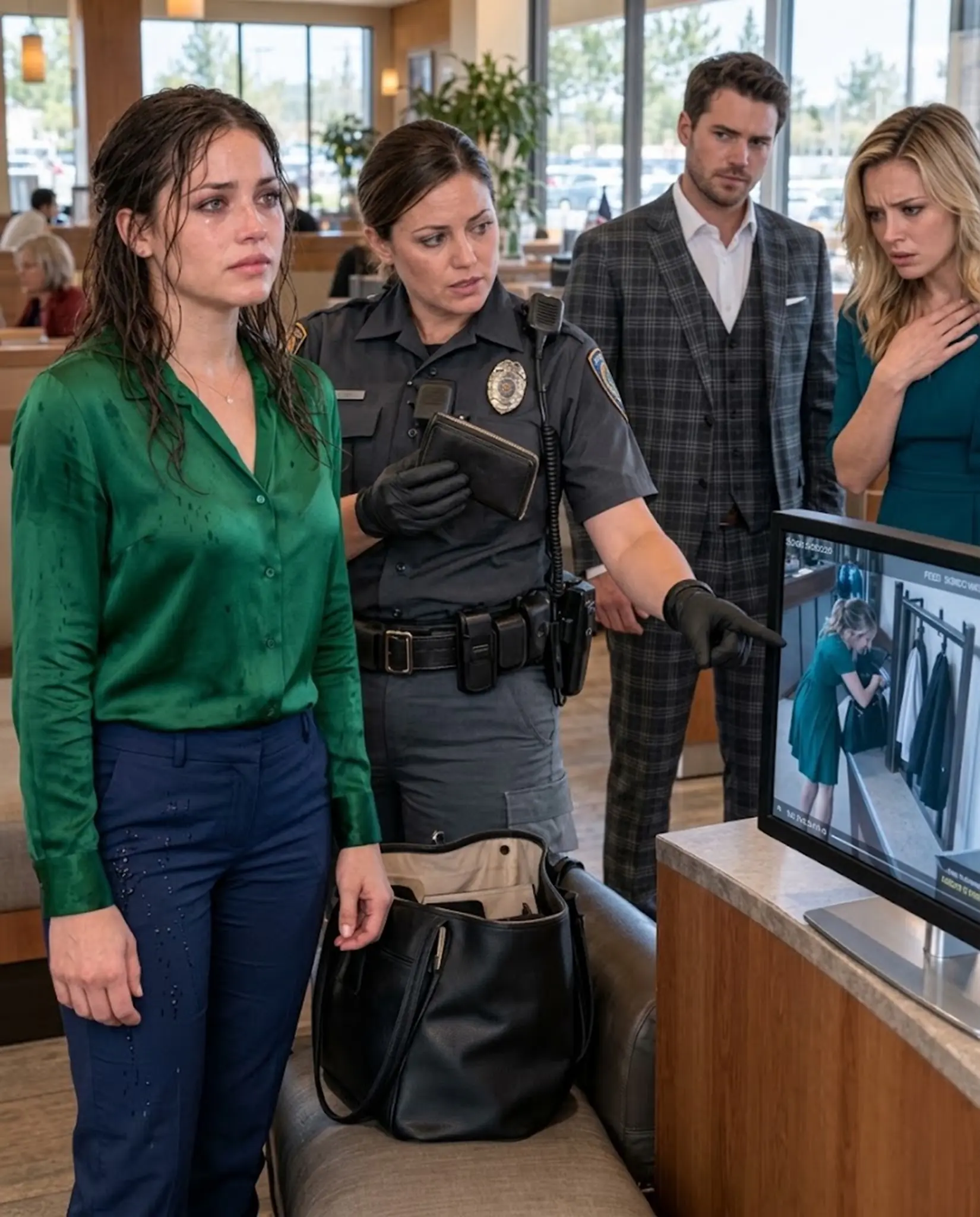
Forty minutes later, I was still soaked when Officer Priya Shaw opened my tote in the lobby of Northline Grill and pulled out Sloan’s black zippered wallet. Her Ohio driver’s license and bank cards were inside.
The money was not.
I knew I had never touched that wallet. Sloan knew it, too.
The question was how her wallet had ended up inside a bag I had carried into the restaurant myself—and why my family had needed less than five minutes to believe I was a thief.
Before I tell you what the police discovered, subscribe to the channel, turn on the notification bell, and like the video. It helps this community keep sharing stories about what happens when family pressure collides with the truth.
To explain the wallet, I have to go back to the beginning of that Saturday evening.
Dad had retired from Riverton Transit after thirty-six years, and his sixty-third birthday had fallen in the same week. Sloan arranged a combined celebration in the private dining room at Northline Grill, a family restaurant off the interstate in suburban Ohio. Gold stars covered the table. A sheet cake waited beneath a clear plastic dome. Near the host stand, a small American flag stood beside a framed photograph of the restaurant’s original owners.
Sloan met me beside the coat station in a green dress and the polished smile she used whenever an audience was present.
“You made it,” she said, embracing me. “Give me those. I’ll put them away.”
She took my coat and shoulder tote before I could answer. I watched her hang the coat and place the tote on the lower shelf. Then she touched my elbow and guided me toward the table as though the previous three weeks between us had never happened.
Caleb raised a hand from the chair beside Dad. Mom was adjusting the candles. Aunts, cousins, and two of Dad’s former coworkers filled the remaining seats. Everyone praised Sloan for arranging the evening. Dad thanked Mom, Caleb, Sloan, and me. Sloan laughed louder than anyone when he joked about finally having time to repair his fishing boat.
For most of dinner, nothing seemed wrong. Servers carried in plates, coffee cups, and baskets of warm rolls. Dad told stories about his first winter driving a city bus. His former coworkers teased him about the retirement watch tucked inside its velvet box. Sloan moved around the room checking place settings, taking photographs, and making certain everyone saw how much work she had done.
The main plates had just been cleared when her expression changed.
She checked beneath her chair, lifted her napkin, and searched the floor.
“Has anyone seen my wallet?”
Caleb leaned down. “Which one?”
“The black zippered one. It was in my purse.”
At first, the search felt ordinary. Chairs shifted. People looked beneath the table and beside the cake stand. Someone checked the hallway. Then Sloan stopped moving and stared directly at me.
“You were beside my purse.”
“When?”
“Before dinner. You came back here while everyone was taking pictures.”
I had returned only to place Dad’s gift near the cake. Sloan knew that because she had pointed out where I should leave it.
“I didn’t touch your purse.”
She folded her arms. “There was $13,000 in that wallet.”
Conversation died throughout the room. Caleb’s chair scraped backward.
“Why were you carrying that much cash?” he asked.
“I sold a block of boutique inventory this afternoon. The bank was already closed.” Her eyes never left mine. “Naomi knew I had a buyer.”
I knew Sloan had been trying to raise money. That was not the same thing.
“You’re accusing me because I wouldn’t invest in your business.”
“I’m accusing you because my wallet disappeared after you went near my bag.”
Mom reached for my wrist. “Let’s settle this quietly. Open your tote.”
“No.”
Her fingers tightened. “If you have nothing to hide—”
“Then Sloan can call the police. She is accusing me of a felony.”
Dad glanced toward the door, embarrassed by the attention of a passing server.
“Nobody is calling the police during my dinner.”
Sloan stepped closer. “Return the money tonight, and I won’t have to.”
That was when I understood she was not looking for anything. She wanted me to produce $13,000 simply because she had spoken the number aloud.
“I am not paying you for money I never saw.”
Sloan grabbed the nearest water glass and flung its contents into my face.
The cold struck my eyes and filled my nose. Ice bounced from my collarbone. Water ran through my hair, over my makeup, and down the front of my blue blouse.
Someone gasped.
No one moved toward me.
Sloan pointed at the door. “Get out before I report you.”
Caleb stood between us, but he faced me.
“Go home,” he said. “We’ll talk when she calms down.”
I stared at him. “She just threw water in my face.”
“And she says you stole $13,000.”
Mom retrieved my tote and coat. She pressed them against my wet blouse as though she were returning property at a lost-and-found counter.
“Please don’t ruin your father’s night,” she said.
Dad remained at the head of the table. He did not say that he believed Sloan, but he did not ask me to stay.
I walked into the lobby with water dripping from my sleeves. Behind me, the private-room door closed. A few seconds later, the muffled sound of conversation resumed.
Elena Morales, the restaurant manager, came from the host stand carrying a thick stack of paper napkins.
“Are you hurt?”
“No, but I’ve been accused of stealing $13,000.”
I looked up at the security camera mounted above the private-room entrance.
“Does that camera record the coat station?”
“Most of it. Why?”
“Please preserve everything from before we arrived.”
Then I called the police myself.
Officer Shaw arrived with another officer and separated us. She listened to me first, photographed my soaked clothing, and asked whether I wanted medical assistance. I declined. At the opposite end of the lobby, Sloan repeated her accusation and added that I had become aggressive when confronted.
“Do you consent to us looking inside your tote?” Officer Shaw asked me.
“Yes.”
She placed it on a bench and removed each item carefully: my wallet, keys, work notebook, phone charger, and makeup pouch. Then she reached into the interior pocket and pulled out Sloan’s black wallet.
Mom covered her mouth.
Caleb stared at me as though the final piece had fallen into place.
Sloan began crying. “Check the cash.”
Officer Shaw opened every compartment. She found Sloan’s license, cards, and receipts.
There was no money.
“She took it,” Sloan said. “She left the wallet because she thought we wouldn’t search her.”
For one sickening second, the object on that bench seemed more powerful than everything my family had ever known about me.
Then I remembered Sloan taking my coat and tote when I arrived.
I told Officer Shaw.
Elena led us into the management office and opened the surveillance archive. The camera angle covered the coat station clearly. At 6:14 p.m., I appeared at the entrance.
On the screen, Sloan embraced me, took my belongings, and turned toward the shelf. Her body blocked part of the view, but not her hands. The black wallet was already in her right hand. She opened my tote with her left, pushed the wallet into the interior pocket, closed the zipper, and placed the bag on the shelf.
Officer Shaw replayed the clip.
Then she returned to the lobby and asked Sloan when she had last touched the wallet.
“At the table,” Sloan said. “Right before it disappeared.”
Officer Shaw turned the screen toward her.
Caleb watched his wife plant the wallet inside my bag. Mom sat down without speaking. Dad stared at the soaked front of my blouse for the first time that evening.
The footage proved Sloan had framed me. It did not prove whether $13,000 had ever been inside the wallet. Before the night ended, Sloan chose to make that part of her lie official.
Officer Shaw gave her an opportunity to correct her statement before anyone wrote another word.
“The recording shows you placing the wallet in Naomi’s bag,” she said. “Do you still want to report that Naomi stole $13,000 from you?”
Sloan wiped her face. “Yes. She took the cash earlier. I put the empty wallet in her bag because I wanted to prove what kind of person she was.”
It was a new story, and it directly contradicted the one she had told in the lobby.
Officer Shaw explained that a formal complaint would be preserved with the video and every witness statement. Sloan signed it anyway.