Part 1: The Christmas I Finally Stopped Paying
My children sat on my parents’ living room floor on Christmas Eve, surrounded by torn wrapping paper and gifts that made the difference between them and their cousins impossible to ignore. My sister Marlene’s twins were opening new iPhones, a MacBook, gold jewelry, and a Disney cruise package, while twelve-year-old Caleb held a seven-dollar board game and nine-year-old Nora carefully hugged a cheap ceramic snowman mug.
My mother looked directly at me.
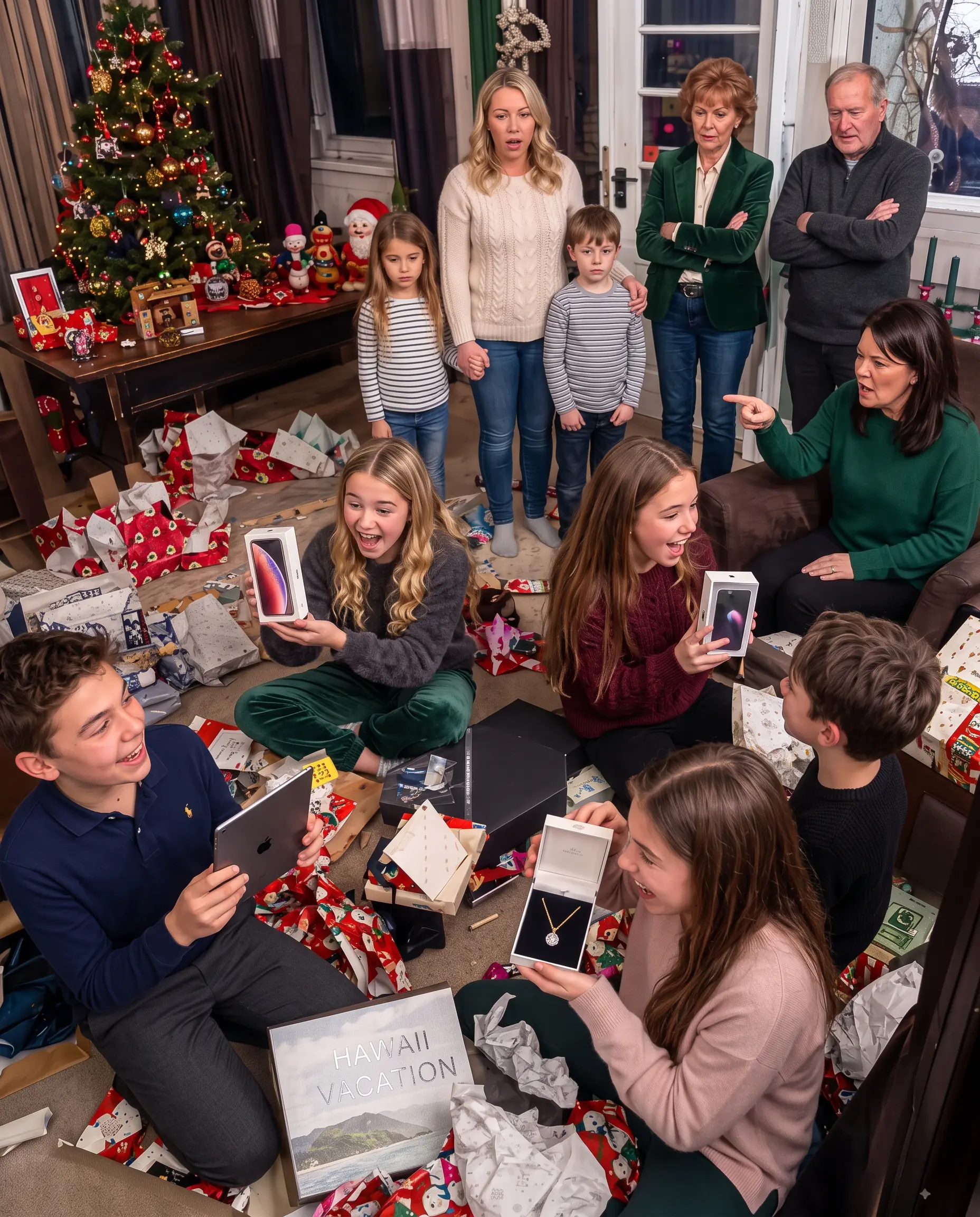
“We don’t do gifts for stepchildren, Susan. Don’t make this awkward.”
My name is Veronica Wilds, although everyone who truly knew me called me Ronnie. My mother used “Susan” whenever she wanted to reduce me to the obedient daughter who paid bills, fixed problems, and swallowed insults because keeping the family peaceful had always seemed more important than defending myself.
My father barely looked away from his bourbon.
“Be grateful they’re included.”
That word hurt more than excluded. Caleb and Nora were not temporary guests in my life because after their father, David, died, I had legally adopted them and raised them as my own children.
Marlene glanced up from her son’s laptop box with a smirk.
“You know how Mom is. Blood gifts are different.”
I looked at Caleb trying not to stare at his cousin’s phone, then at Nora rubbing her thumb across the snowman mug and pretending to treasure it because I had taught her to be polite. What none of them seemed to remember was that much of the generosity surrounding us had actually been financed by me.
The Disney cruise deposit had come from my card. I had helped catch up my parents’ mortgage, paid Marlene’s overdue car insurance, covered her previous car payment, maintained the family phone plan, and even financed much of the Christmas dinner.
Something inside me finally became quiet.
I took Caleb’s hand, then Nora’s.
“We’re leaving.”
My mother frowned.
“Susan, don’t be dramatic.”
At the doorway, I turned toward her.
“No. Dramatic is pretending generosity with someone else’s money.”
My father immediately stood.
“Watch your mouth in my house.”
I almost laughed because I had contributed more reliably to that house’s mortgage than the man claiming authority over it. Instead, I walked outside with my children and drove home through the freezing Baltimore night.
Caleb stared through the window with the board game on his lap. Nora continued holding her mug, and I could see that both children were trying to protect me from how badly they had been hurt.
“You did nothing wrong. Not one thing.”
Caleb nodded silently.
“I know,” Nora whispered.
But I knew she didn’t.
After putting them to bed, I sat at my kitchen table and opened my laptop. At 10:47 p.m., I began reviewing every financial connection I still had with my family.
By 2:13 a.m., I was finished.
I stopped the mortgage transfer to my parents’ lender and removed their utilities from my automatic payments. I scheduled the family phone plan for termination, canceled the remaining Disney cruise payment, removed Marlene’s car insurance from my policy with proper notice, froze the shared credit card, and transferred my emergency savings into an account only I controlled.
It didn’t feel like revenge.
It felt like finally closing a wound that everyone else had been keeping open.
By morning, my phone showed sixty-nine missed calls. My parents, Marlene, and relatives I barely spoke to had spent hours trying to reach me.
Then, at 8:11 a.m., someone knocked on my front door.
Two police officers were standing outside.
Behind them, my mother sat crying inside my parents’ car while my father stood on the curb looking furious. They had reported me as emotionally unstable and requested a welfare check because of my “sudden financial decisions.”
My father tried to push toward the doorway.
“She stole from us. She cut off the house.”
I calmly retrieved a binder containing twenty-eight months of bank statements, mortgage confirmations, utility bills, insurance records, and other payments. Almost every page documented money leaving my accounts to support the same people now accusing me of stealing from them.
The officers quickly realized what was happening and ordered my family to leave. I closed the door while my mother was still begging me to “talk like family.”
I thought that humiliation would finally make them stop. Instead, that evening Caleb walked into my bedroom holding his tablet, tears filling his eyes.
“Mama, why did Aunt Marlene put that on Facebook?”
I looked at the screen. And realized Christmas Eve had only been the beginning.
Part 2: They Planned to Humiliate My Children
Caleb stood beside my bed holding his tablet, tears gathering in his eyes. On the screen was a photograph from Christmas Eve showing him and Nora sitting together with their cheap gifts while their cousins opened electronics, jewelry, and the cruise package.
Marlene had posted the picture on Facebook with a caption that made my stomach tighten.
“Some people marry into children and expect the whole world to pretend they’re real grandchildren. Love doesn’t work by invoice.”
The comments underneath were even worse, with relatives saying my children should be grateful they were included and insisting nobody owed “stepkids” equal treatment. Caleb had read every line, and a few minutes later Nora walked into the room clutching her snowman mug against her chest.
“Are we fake grandchildren?”
That question hurt more than anything my parents had said to me. I sat both children on my bed and explained that they were not fake, temporary, or less deserving of love because they weren’t biologically related to my parents.
They had been loved by their father, David, and after he died, I had chosen them, legally adopted them, and promised to remain their mother for the rest of my life. No bitter adult with a Facebook account had the authority to decide their worth.
Nora cried quietly against my sweater while Caleb fought his tears until he couldn’t anymore. After getting them settled, I saved screenshots of Marlene’s post and every relevant comment because my career in operations had taught me that documentation mattered far more than emotional arguments.
Years earlier, my father had asked me to create a shared family cloud account because he wanted everyone’s photographs in one place and could never remember passwords. He had never changed the permissions, which meant I still had access to material my family apparently forgot was being synchronized.
The first things I discovered were screenshots of private messages between my mother and Marlene. They weren’t discussing how to repair what happened at Christmas because they were simply waiting for me to surrender and start paying again.
“Don’t worry, Veronica will pay once she cools off. She always does.”