Aaron caught Sylvia by the wrist and dragged the silver cup toward himself.
On the security monitor, the movement looked almost casual at first.
Then Sylvia resisted.
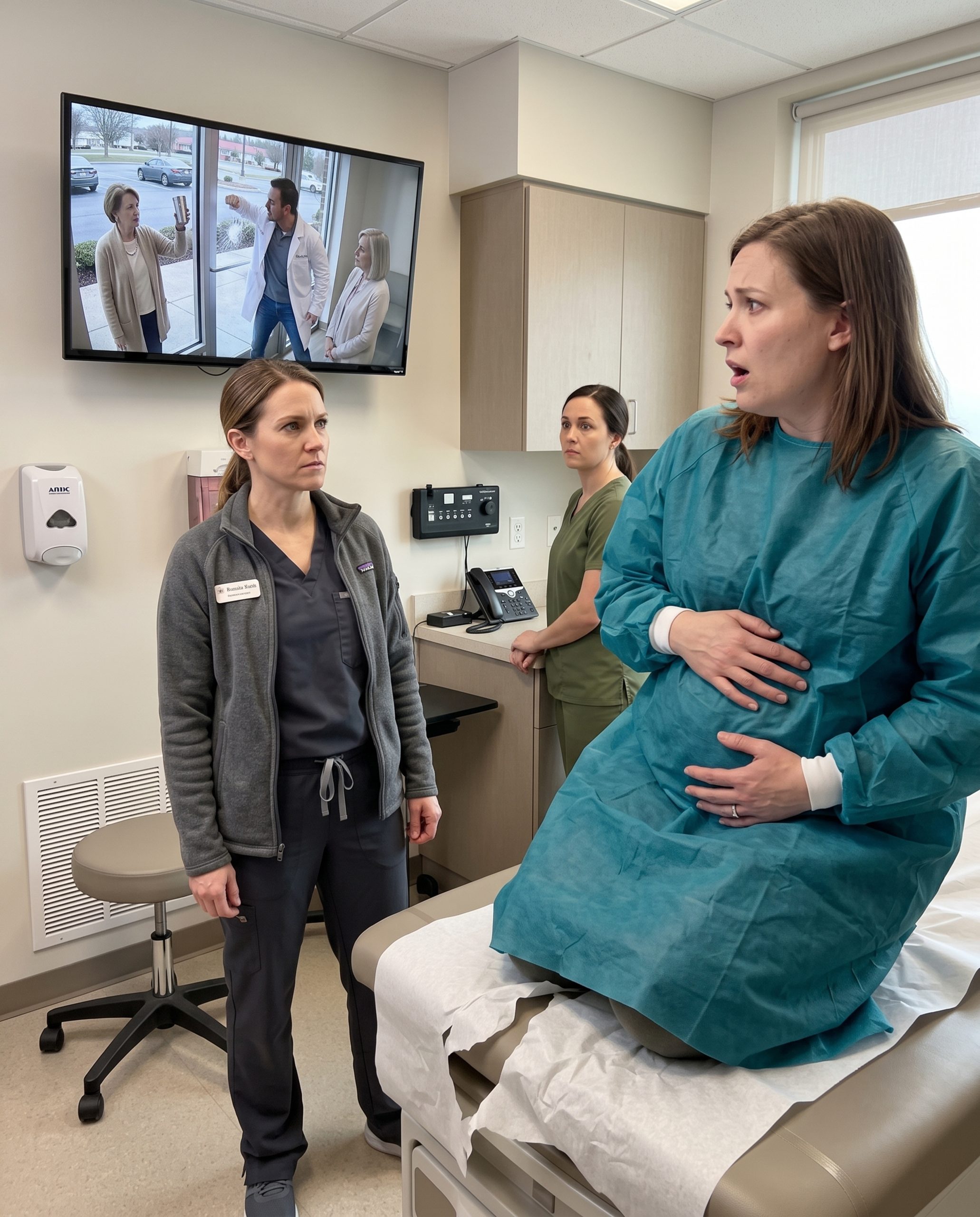
Her elbow locked against her side. Her fingers tightened around the handle. Aaron pulled again, harder this time, and the polished cup jerked between them.
Dr. Reed leaned toward the screen.
“Keep recording.”
The nurse was already saving the footage.
I sat frozen in the wheelchair with both hands wrapped around my stomach. My son moved beneath my palms, a slow roll this time, and that tiny pressure kept me anchored to the room.
Aaron had always been careful about appearances.
He never needed to shout when people were watching.
He could take my keys while smiling. Cancel dinner with my parents while explaining that pregnancy had made me emotional. Tell a driver where I was allowed to go and make it sound like a favor.
But outside that clinic door, he had forgotten the glass was transparent.
Sylvia said something to him.
Even without sound, I knew she was angry.
Aaron’s head snapped toward her.
She pulled the cup back against her cardigan.
He reached again.
This time she stepped away.
The nurse looked at Dr. Reed. “Should I call security again?”
“Yes.”
Dr. Reed turned toward me. “And we’re moving you away from this window.”
The nurse pushed my wheelchair into an interior examination room while another staff member lowered the blinds. My phone kept vibrating on the counter where Dr. Reed had left it.
Aaron.
Aaron.
Sylvia.
Then Aaron again.
I stared at his name until the screen went dark.
Five minutes earlier, I had been afraid that refusing his call would make him angry.
Now I was beginning to understand something worse.
His anger had been controlling my decisions long before he showed it.
Dr. Reed sat across from me instead of standing over me.
“I want to explain what I know and what I don’t know,” she said. “The imaging shows a small foreign medicated insert positioned unusually high near your cervix. It is not part of routine prenatal care, and nothing in the history you gave me explains why it’s there.”
I stared at her.
“Could Aaron have put it there?”
“I cannot tell you who placed it.”
“When?”
“I can’t tell you that yet either.”
Her answer frightened me, but I also noticed what she was doing.
She wasn’t guessing.
She wasn’t trying to make me hate my husband.
She was giving me facts and leaving the choices to me.
It felt almost unfamiliar.
“What happens now?”
“We need more detailed imaging, monitoring for the baby, and a specialist who can determine whether it can be removed safely. Your blood and urine samples are already being processed.”
I looked toward the closed door.
“And the drinks?”
“If that cup contains what you’ve been drinking, preserving it could matter.”
Outside, something struck the entrance again.
Not hard enough to break the glass.
Hard enough that everyone heard it.
My shoulders jumped.
Dr. Reed did not.
“Anna,” she said quietly, “do you want your husband involved in your medical decisions today?”
The old answer arrived automatically.
He’s a doctor.
He understands these things.
He’ll be furious if I embarrass him.
Then I remembered the paperwork beneath my hand.
My signature.
Not his.
“No.”
The word came out small.
Dr. Reed waited.
I said it again.
“No. I don’t want him making decisions for me.”
“Okay.”
That was all.
No applause. No speech about courage. The nurse simply documented my decision and handed me a copy.
For the first time in years, a boundary I set became a fact instead of the beginning of an argument.
A few minutes later, the security staff member called the examination room.
Dr. Reed answered.
Her expression sharpened as she listened.
Then she put the call on speaker after asking my permission.
A man’s voice came through. “The mother-in-law wants to speak to the patient. The husband says she isn’t permitted to.”
I almost laughed.
Not because anything was funny.
Because the sentence was so absurd that it finally exposed the structure of my marriage in plain language.
Aaron was standing outside a clinic he did not control, telling another adult woman whether she was allowed to speak to me.
Dr. Reed looked at me.
“Do you want to speak with Sylvia?”
I hesitated.
Then nodded.
“Only her.”
The connection changed.
For several seconds, I heard breathing.
Then Sylvia’s voice came through, thinner than I had ever heard it.
“Anna?”
“Yes.”
“Aaron told me those packets were prenatal supplements.”
My stomach tightened.
Dr. Reed raised one finger, silently reminding me not to lead her.
“What packets?” I asked.
Sylvia swallowed audibly.
“The ones for your morning drink.”
The room became very still inside me, even though the clinic itself remained busy beyond the door.
“How long?”
“Since he gave them to me.”
“How long, Sylvia?”
“Months.”
I closed my eyes.
Every morning.
The silver cup beside my bed.
Sylvia waiting until I finished.
Her patient smile when I complained about the bitter taste.
Aaron telling me dizziness was normal during pregnancy.
My knees going weak in the shower twice.
The afternoon I slept nearly five hours and woke to discover my car keys were gone again.
“You knew I didn’t want them?” I asked.
“No. He said you did know.”
Behind Sylvia, Aaron’s voice erupted.
“Stop talking.”
Then his voice came closer.
“Mom, give me the phone.”
Sylvia shouted back, “You told me it was safe.”
Dr. Reed’s eyes met mine.
There it was.
Not proof of everything.
But proof of something.