The scrape of something heavy against the floor came from Maya’s closet, inches from where I lay hidden beneath her bed.
I saw the wheels first.
A small black carry-on rolled into view, overstuffed enough that the zipper strained around the corners, and Maya pulled it toward the younger girl with both hands.
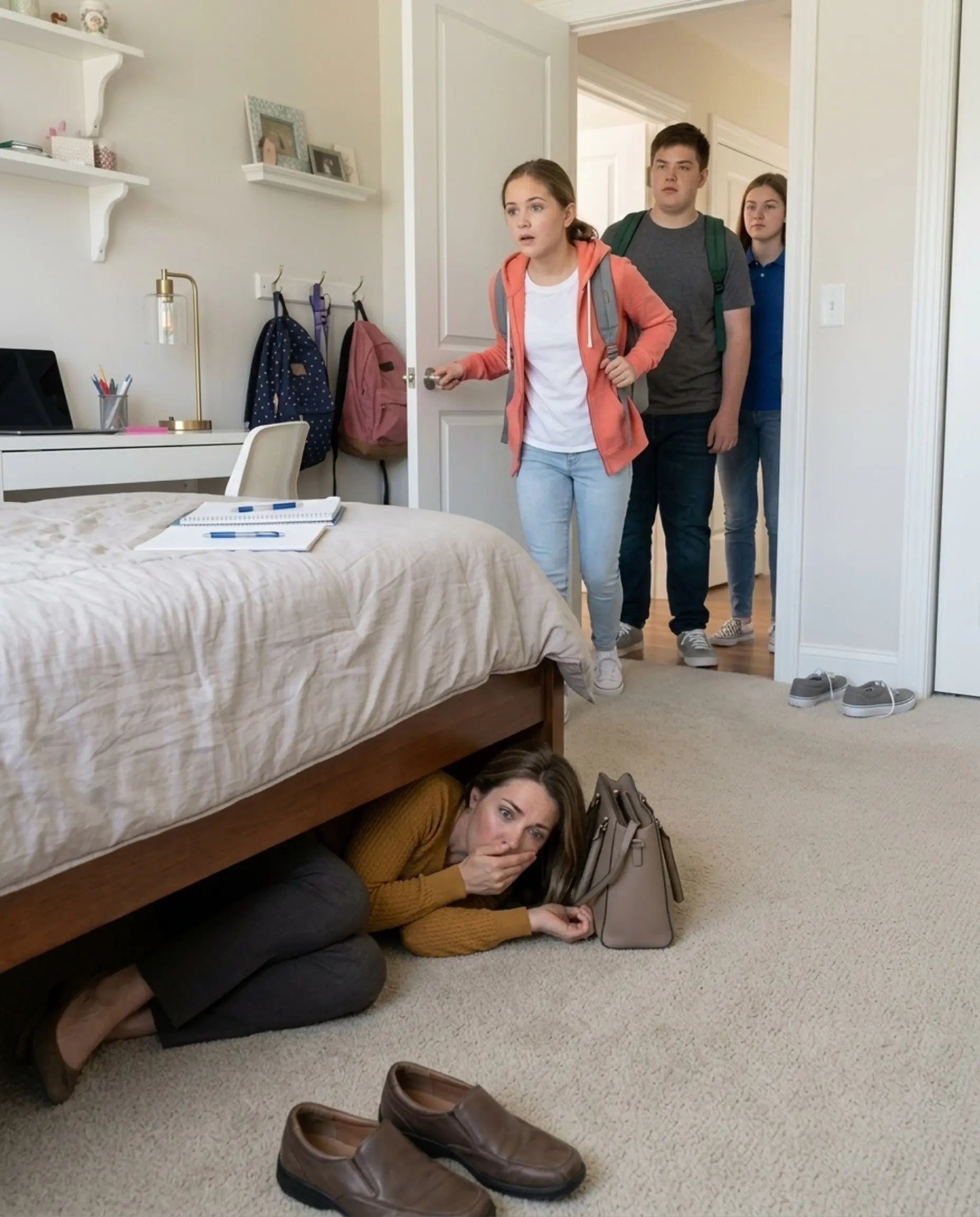
My first thought was simple.
They were running away.
My second thought was worse.
They had planned this before today.
The boy nearest the door crouched beside the suitcase and checked the zipper while the younger girl hugged herself so tightly her shoulders nearly touched.
Maya knelt in front of her.
“You can take my sweatshirt,” she murmured. “And there’s food in the side pocket.”
That did it.
I slid out from under the bed.
Maya screamed.
One boy backed into her desk hard enough to rattle the pencil cup, while the other moved instantly between me and the younger girl.
My daughter just stared.
“Mom?”
Her face went white.
For a second, nobody seemed to know what kind of danger I was.
That hurt more than I expected.
I pushed myself to my knees, dust clinging to my blouse, and held both hands where they could see them.
“I’m not angry right now,” I said.
Maya swallowed.
“You were under my bed.”
“Yes.”
“That’s really weird, Mom.”
“Agreed.”
The older boy almost laughed, but the sound died before it escaped.
I pointed toward the suitcase.
“Tell me what’s happening.”
Maya’s eyes filled immediately.
Not dramatic tears.
Not the kind she used when she was six and wanted ten more minutes before bedtime.
These were exhausted tears, the kind that had been waiting behind her face for days.
“I was going to tell you,” she said.
“When?”
“When I knew she was safe.”
The younger girl flinched at the word safe.
I noticed it.
I noticed everything now.
I noticed the sleeve she kept pulling over one wrist.
I noticed the boy beside her watching the bedroom door every few seconds.
I noticed Maya’s pink backpack open beside the dresser, half-empty except for two granola bars and a bottle of water.
Suddenly, the missing snacks made sense.
So did the lunches Maya claimed she had stopped liking.
So did the dirty school uniform.
So did the late-night laundry.
So did the way she jumped whenever her phone buzzed.
I sat on the carpet.
“Start at the beginning.”
Maya looked at the kids.
The older boy nodded.
The younger girl didn’t.
Maya waited anyway.
That was the first moment I understood that my daughter had not been ordering these children around.
They trusted her.
Finally, the girl whispered, “My name is Evelyn.”
The older boy was Benjamin, her brother.
The third child was a friend from school who had been helping them keep watch.
All of them were young enough that I should have been asking what they wanted for lunch, not why they were hiding inside my house during school.
Benjamin spoke first.
Things at home had been getting worse for months, he said.
Their father’s anger had become unpredictable.
He took phones when he thought the kids were talking about him.
He blocked doors during arguments.
He punched walls close enough to make them jump.
He told them private family problems stayed private.
And two nights earlier, an argument had ended with Evelyn getting hurt while trying to leave the room.
Benjamin stopped talking.
His jaw tightened.
Evelyn looked down.
Maya reached for her hand.
I didn’t ask Evelyn to show me anything.
I didn’t need to.
The fear in that room was not teenage theater.
It had weight.
It had rules.
It had taught three children how to whisper in a locked bedroom at nine-thirty in the morning.
“How long have you been coming here?” I asked.
Maya answered quietly.
“Almost three weeks.”
Three weeks.
The number landed hard.
They had not come every day.
Only on mornings when Benjamin sent Maya a certain message before school, or when Evelyn arrived frightened enough that she refused to go home if someone called her father.
My house was close enough that they could reach it without a car, and Maya knew I would already be at work.
They would stay until they felt safe enough to leave, sometimes returning to school later and sometimes missing most of the day.
It was reckless.
It was dangerous.
It was also thirteen-year-old logic trying to solve an adult problem with crackers, Band-Aids, clean socks, and an empty house.
“What was the suitcase for?” I asked.
Benjamin rubbed both palms over his jeans.
Evelyn answered.
“I didn’t want to go back tonight.”
Maya looked at me quickly, already preparing to defend her.
“I told her she couldn’t just disappear,” she said. “I told her we needed an adult. I was trying to figure out which adult.”
I stared at her.
“You had one.”
Her mouth trembled.
“I didn’t know if you’d listen first.”
That sentence cut deeper than any lie she had told me.
I started to argue.
I stopped.
After the divorce, I had become obsessed with keeping our life orderly.
Bills got paid on Fridays.
Laundry got done before Sunday night.
Homework came before television.
If Maya had a problem, we talked about it.
If a child was in trouble, I had always said, adults needed to know.
But I had never explained that some adults could not safely be the first adults called.
Maya had filled in that blank herself.
“I thought you’d call her dad,” she whispered.
“No.”
She blinked.
“No?”
“Not after hearing this.”
Evelyn finally looked at me.
Her eyes were red and suspicious.
“Are you going to make us leave?”
“No.”
“Are you going to call him?”
“No.”
Benjamin’s shoulders dropped half an inch.
I pointed toward Maya’s desk chair.
“Everybody sits. Nobody goes anywhere alone. We are going to get help, but I’m going to tell you what I’m doing before I do it.”
Maya covered her face.
A sob slipped through her fingers.
I wanted to hug her.
Not yet.
First, I needed to become the adult she had been afraid to trust.
I asked Evelyn whether she needed medical attention.
She shook her head.
Benjamin said the bandages were for a scrape she had covered badly that morning.