The mornings in New England possess a distinct, heavy kind of silence, particularly at 5:00 AM. It is a quiet that doesn’t just sit in the room; it presses against your chest, suffocating and cold. My internal clock, forged in the fires of thirty years of emergency room nursing shifts, refused to let me sleep past that hour. Even now, two years into retirement, my body remained institutionalized. But on this specific morning, it wasn’t just habit that woke me. It was a phantom weight on my sternum, a premonition wrapped in frost.
I lay there in the gray, pre-dawn gloom, the cold autumn air seeping through the window frame, and I stared at the ceiling. My body was awake, but my soul felt as though it had been dragged across a floor of broken glass.
It had been ten years since my husband, Tom, collapsed in our kitchen, his heart simply deciding to stop. I had performed CPR with the mechanical precision of a professional, but as a nurse, I had looked death in the face a thousand times. I knew the pallor, the terrifying stillness. Losing a patient was a tragedy; losing Tom was an amputation.
But Jessica… my beautiful, vibrant Jessica, was supposed to be the one who outlived us all.
She was my anchor, a successful graphic designer who radiated warmth and color in a world I often saw in clinical shades of gray. Five years ago, she married Derek Miller, a charming, high-end real estate agent with a smile that could disarm a bank vault. I had thought him a good man. I had trusted him with my only child.
Two days ago, that trust shattered. The call came in the dead of night. Jessica collapsed. Heart failure. Dead at thirty-five.
The diagnosis was a jagged pill my medical background refused to swallow. She hiked. She ate organic. Her blood pressure was textbook perfect. A healthy thirty-five-year-old woman does not simply drop dead from a spontaneous cardiac event without underlying pathology. But grief is a tidal wave; it drowns logic.
I forced myself out of bed, pulling on the black mourning dress that smelled faintly of cedar and old sorrow. As I arrived at Derek’s sprawling suburban estate to pick up my seven-year-old grandson, Ethan, the front door swung open.
Derek stood framed in the doorway. He wore a tailored charcoal suit, his hair perfectly coiffed, his shoes polished to a mirror shine. There were faint shadows under his eyes, but his posture was unnervingly rigid. He didn’t look like a man whose world had just ended; he looked like a CEO preparing for a hostile takeover.
“Good morning, Carol,” Derek said, his voice a smooth baritone, entirely devoid of tremor.
“Derek,” I managed, my throat tight. “How is Ethan?”
“He’s quiet. Which is for the best.” Derek stepped out onto the porch, closing the heavy oak door behind him. He checked his gold wristwatch. “Listen, Carol, there’s been a slight change of plans regarding the arrangements.”
I frowned, the crisp morning air suddenly biting at my skin. “What do you mean? The service is at ten.”
“The service is proceeding. But I’ve canceled the burial.” His eyes locked onto mine, flat and unreadable. “I’ve authorized an immediate cremation. It will happen directly after the chapel service today.”
My breath hitched. “Cremation? Derek, no. We haven’t even had an autopsy done! The hospital released her body on a presumptive diagnosis, I haven’t even seen the coroner’s full report—”
“There will be no autopsy, Carol,” he interrupted, his voice dropping an octave, laced with a velvet threat. “Jessica hated hospitals. She hated being poked and proded. I will not have my wife treated like a science experiment on a slab. She loved the ocean. She wanted to be ash on the wind.”
“Derek, she died suddenly! We need to know why—”
He took a step closer, invading my personal space. The scent of his expensive cologne was nauseating. He placed a heavy hand on my shoulder, his fingers digging into my collarbone just hard enough to hurt.
“She died of a broken heart, Carol. The stress of her business, the anxiety… it was too much,” Derek whispered, his breath hot against my cheek. “Do not make a scene today. Do not embarrass her memory. If you try to delay this cremation, if you make me look like a villain in front of this town, I promise you, I will take Ethan to California by the end of the week. You will never see your grandson again. Am I clear?”
I stared into the eyes of my son-in-law, and for the first time, I didn’t see a grieving husband. I saw a predator guarding a kill.
“Crystal,” I whispered.
He smiled, a terrifyingly hollow expression, and released me. “Good. Let’s go bury my wife.”
The clock is ticking, a voice screamed in my head. In four hours, whatever secrets her body holds will be reduced to ash.
Ethan sat in the passenger seat of my sedan, looking like a porcelain doll dressed in a miniature black suit. He had always been an unusual child. When he was three, he started talking to Tom’s empty leather armchair, relaying messages from my dead husband with an uncanny, terrifying accuracy. Over the years, I had learned that Ethan didn’t just have an active imagination; he was a conduit.
We drove toward the Golden Willow Funeral Home in oppressive silence. I gripped the steering wheel, Derek’s threat echoing in my skull. Immediate cremation. No autopsy. Move to California.
I needed to protect my grandson, but a sickening dread pooled in my stomach. What was Derek hiding?
Suddenly, Ethan gasped. It wasn’t a normal intake of air. It was a wet, desperate, rattling sound. I slammed on the brakes, pulling the car onto the shoulder of the road.
“Ethan! Honey, what is it? Are you choking?” I unbuckled my seatbelt, reaching for him.
His small hands were clawing at his throat, his eyes wide and unseeing, fixed on the dashboard. “Can’t… breathe,” he wheezed. Then, his hands flew down to his stomach, wrapping around his midsection as if he were trying to hold his own organs inside. His face contorted in an agony that belonged to a grown woman, not a seven-year-old boy.
“Ethan, look at me!” I panicked, my nurse’s training fighting against the sheer supernatural terror of the moment.
“Grandma,” Ethan choked out, his voice dropping into a raspy, unfamiliar cadence. It was an echo of Jessica. “He pushed… it hurts… the baby… save the baby…”
The blood drained from my face. The baby?
“Ethan, who pushed? What baby?” I grabbed his shoulders, feeling the violent tremors wracking his tiny frame.
Ethan’s eyes snapped back to focus on me, filling with hot tears. The unnatural cadence vanished, replaced by the terrified voice of my grandson. “Mommy is here, Grandma. She’s in the backseat.”
I whipped my head around. The backseat was empty. Just the worn leather upholstery and an old umbrella.
“She’s crying, Grandma,” Ethan sobbed, pointing a trembling finger at the empty space. “She looks so scary. She’s wet. She’s sweating. There are purple marks on her neck. She says… she says she couldn’t breathe. She says he stepped on her.”
Purple marks on her neck.
A wave of nausea washed over me. Petechiae. Bruising. Strangulation.
“She says he’s going to burn her, Grandma,” Ethan cried, gripping my sleeve with surprising strength. “She says you can’t let him burn the proof. He’s going to burn the baby.”
My mind raced, assembling the jagged, horrific pieces of a puzzle I hadn’t known I was solving. Jessica hadn’t died of heart failure. Jessica had been murdered. And she was pregnant.
I pulled the car back onto the road, my foot heavy on the accelerator. We arrived at the funeral home just as the parking lot began to fill. The grand, somber building smelled of death disguised as lilies.
Derek was already in the foyer, shaking hands with Jessica’s colleagues. He looked like the picture of stoic grace. When he saw me, he excused himself and glided over, his eyes darting to Ethan.
“You look pale, Carol,” Derek noted, his voice dripping with loud, performative concern for the benefit of the surrounding mourners. He leaned in close. “I hope you aren’t having one of your episodes.”
“I’m fine,” I gritted out.
Derek sighed, turning to a nearby usher. “My mother-in-law has been struggling with dementia since her husband passed. The grief is making her hallucinate. Please keep an eye on her during the service.”
He was laying the groundwork. Gaslighting me in front of witnesses. If I screamed murder, they would just see a crazy, grieving old woman. He would call security, have me institutionalized, cremate my daughter, and take Ethan away.
“It’s time to be seated,” the funeral director, a nervous young man named Steven, announced softly.
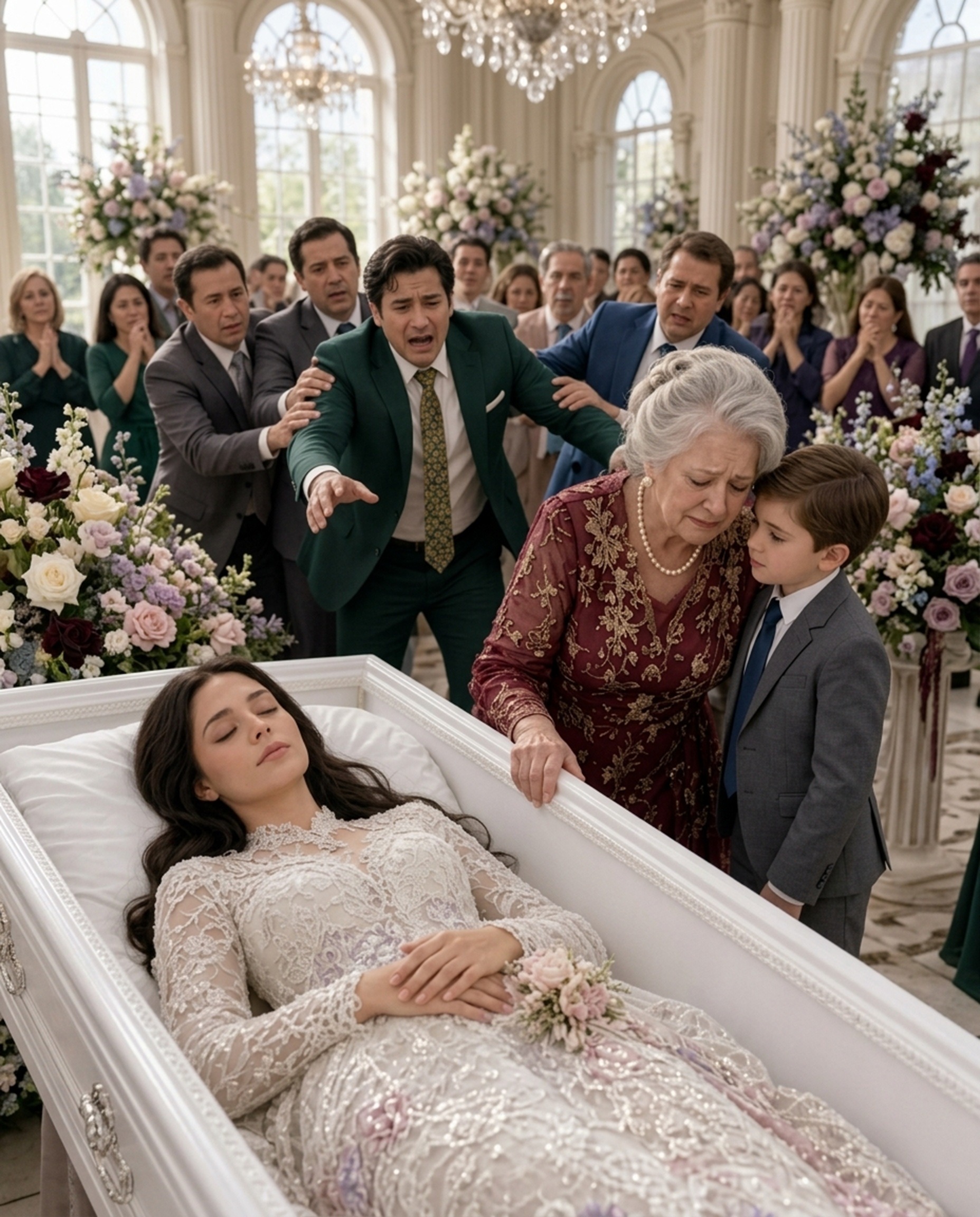
We walked into the chapel. The closed mahogany casket sat at the front, surrounded by white roses. The furnace, I knew, was in the basement directly below us. Waiting.