“Don’t you dare touch my back! Get your hands off me, or I swear to God I will scream until the police arrive!”
Edith Ledbetter’s voice tore down the sterile, linoleum-tiled hallway of Oakridge Senior Living, stopping the entire floor cold. It froze the old gentleman trembling over his soup in the dining room, froze the aide pushing the squeaking linen cart, and it froze me.
Everyone at Oakridge knew that voice. Edith had lived with us for nearly three years. At seventy-six, she walked without a cane, filled in the Sunday crossword without her reading glasses, and could argue for a solid hour that dark roast beat instant coffee and mean every single syllable. She was sharp, fiercely proud, and in almost every way, one of the least troublesome residents we had.
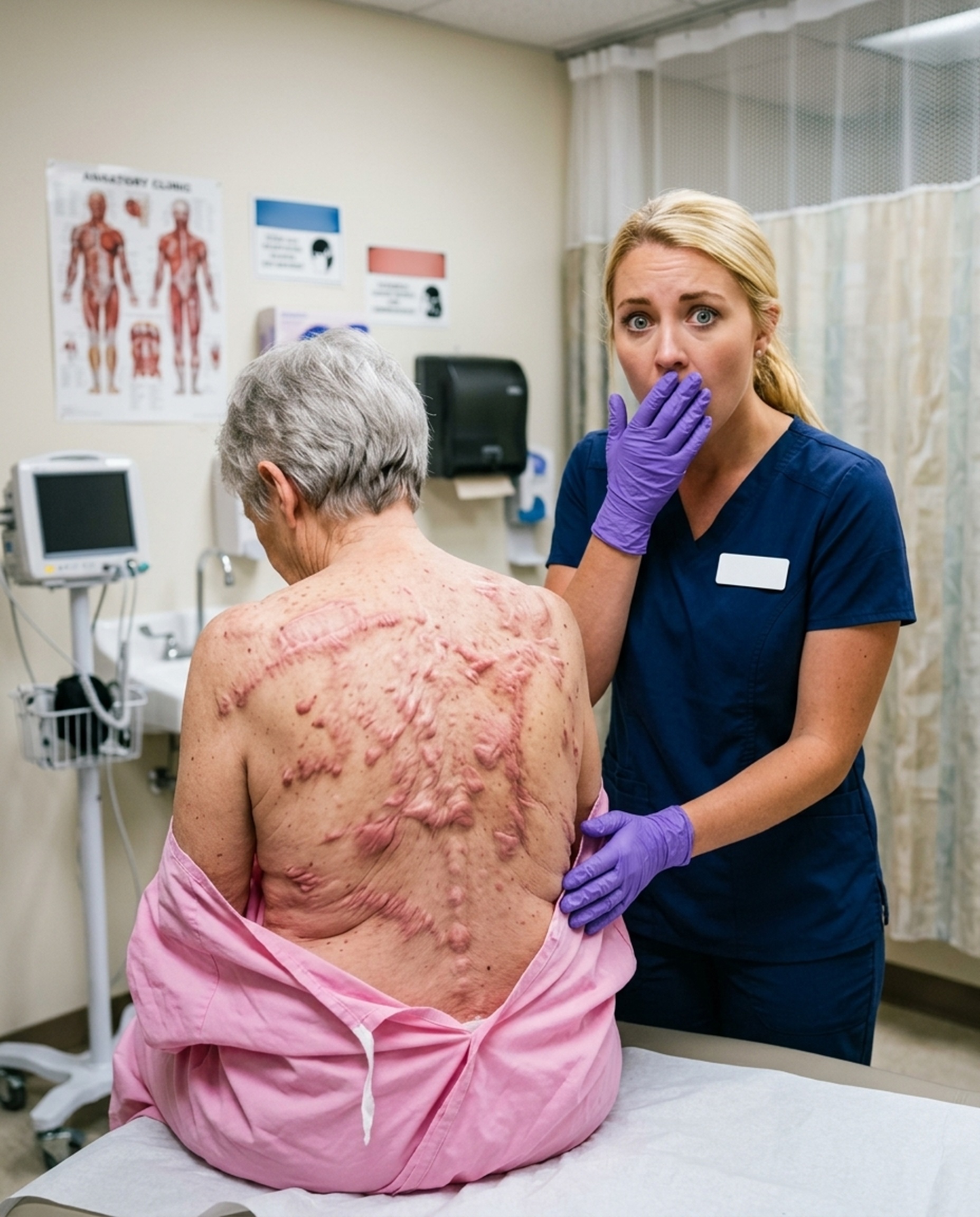
Except for one thing. Nobody had ever been allowed to wash her back.
She would let you help with her face, her hands, even her hair if she was in a forgiving mood. But if a caregiver’s hand drifted anywhere near her shoulder blades, the woman shattered into a state of absolute, feral panic. She screamed, she slapped hands away, and she locked herself in the bathroom. Whatever was on Edith’s back, she had decided long ago that no living person was ever going to see it.
For a long time, I assumed it was just an old woman’s stubbornness. I was twenty-four, a nursing school dropout named Hailey, drowning in student debt after my mother lost her job. I took the job at Oakridge out of sheer desperation. I thought the work was medical—pills in paper cups, blood pressure cuffs, and bedpans. I didn’t know that an assisted living facility is, fundamentally, a warehouse for people the world has decided to stop looking at.
But Edith’s refusal had finally caught up with her.
That morning, the facility director, Ms. Higgins, had pulled me into her office. The room smelled overwhelmingly of cheap air freshener and corporate anxiety.
“The State Health Inspectors are coming on Friday, Hailey,” Higgins had said, her manicured fingers tapping impatiently on Edith’s thick file. “Three days. That’s exactly seventy-two hours. Edith Ledbetter is a walking compliance violation. We have a resident who refuses basic hygiene, and it’s documenting poorly.”
“She washes her front,” I argued weakly. “She just has a phobia about her back.”
Higgins slammed the file shut. “I don’t care if she’s afraid of ghosts. If she doesn’t allow a full, documented bath by Thursday evening, I am declaring her a danger to herself. I’ve already drafted the transfer paperwork for Sunny Pines psychiatric ward. They have the authority to sedate and forcefully bathe non-compliant patients. Seventy-two hours, Hailey. Get it done, or pack her bags.”
The cruelty of it made my stomach churn. Sunny Pines was a nightmare, a grim, underfunded state facility where residents were medicated into silent compliance.
I left the office with a cold dread coiling in my gut. I went straight to Room 7, determined to gently talk to Edith. I found her sitting by the window, wearing a thick, floral cardigan despite the stifling summer heat pushing through the glass.
“Edith,” I began softly, approaching her chair. “We need to talk about…”
I reached out, just wanting to rest a reassuring hand on her shoulder. My fingertips grazed the fabric over her shoulder blade. Just a brush. Half a second.
Edith shot up from the chair as if she’d been struck by lightning. Her hand clamped around my wrist with a terrifying, desperate strength. Her pale eyes were wide, dilated with a terror so old and deep it stole the breath from my lungs.
“Not my back,” she whispered, her whole body shaking violently. “Never.”
I backed away, hands raised in surrender, my heart hammering against my ribs. “I’m sorry. I’m so sorry, Edith.”
“Well, well. Adding physical assault to your list of stellar caregiving achievements, Hailey?”
I spun around. Standing in the doorway was Vanessa, the senior floor nurse. Her arms were crossed, a clipboard pressed against her chest, and a cruel, triumphant smirk playing on her lips. Vanessa despised me. She saw my empathy as a weakness and my lack of a nursing degree as an insult to her profession.
“I didn’t hurt her,” I stammered.
Vanessa’s eyes flicked to Edith, who was still trembling against the window, then back to me. “Ms. Higgins is looking for a reason to clean house before the inspection. I think a report of you traumatizing a resident ought to do it. Consider yourself done here.”
Vanessa turned on her heel, her rubber-soled shoes squeaking against the linoleum as she marched toward the director’s office, taking my last paycheck, and Edith’s last hope, with her.
I chased Vanessa down the hall, begging her to listen, but she waved me off and disappeared behind the heavy mahogany door of Higgins’s office. I was left standing in the corridor, the fluorescent lights humming a sickly yellow tune overhead. I expected security to escort me out within the hour.
But the axe didn’t fall. Not that day. Apparently, Higgins was too preoccupied with a different disaster to fire me immediately.
The next morning, the real threat arrived.
His name was Carter, Edith’s only son. He lived two hours away in a wealthy suburb of Chicago, and he usually only called when he remembered to, showing up every few months with a box of stale, store-bought cookies as though sugar could pay off the debt of his absence.
But today, Carter didn’t bring cookies. He brought a man in a sleek, charcoal-gray suit carrying a leather briefcase.
I was changing the linens in the room next to Edith’s, the door cracked open just enough for me to hear the heavy, polished footsteps echoing down the hall.
“Just let me do the talking, Carter,” the man in the suit said. His voice was smooth, oiled with professional apathy. “Given the facility’s documentation of her… unruliness, and this impending transfer to the psychiatric ward, the judge will grant the emergency Power of Attorney without a hitch.”
Power of Attorney. The words hit me like a physical blow.
I crept closer to the adjoining wall, pressing my ear against the cool plaster.
“I need that house listed by Monday, Mr. Vance,” Carter hissed, his voice tight with an ugly, frantic energy. “My creditors are breathing down my neck. If she’s deemed incompetent, I can liquidate the estate. This refusal to bathe, the screaming… it’s perfect. It proves she’s lost her mind. She’s a liability to herself.”
“The psychiatric transfer on Thursday will be the final nail in the coffin of her legal autonomy,” the lawyer, Vance, replied calmly. “Once Higgins signs the transfer, your mother becomes a ward of the state in practice, and you become the executor in reality. It’s clean.”
My blood ran ice cold. Carter wasn’t here to save his mother from Sunny Pines. He was banking on it. He needed her labeled insane, uncooperative, and dangerous so he could strip her of her rights, sell the home she and her late husband had built, and cover his own gambling debts. He was weaponizing her trauma.