The black plastic handle of my landline receiver was slick against my ear, and the coffee in my mug had gone completely cold. Thomas Kelly did not pause to let me speak between his sentences.
“I just need a little more time to submit the paperwork, Mr. Kelly,” I said, reaching back to rub the small of my spine where the dull ache of thirty-four weeks had settled.
“We have rigid guidelines for these accounts, Ms. Miller, and exceptions are rare,” Kelly said. The rhythmic, sharp tapping of a silver pen against his leather folder stopped for a brief second, then resumed.
“I understand that, but my hours at the clinic were cut when my pregnancy became high-risk,” I said, keeping my voice as quiet and level as I could. “Once the baby is born, I have a remote bookkeeping position lined up. I can catch up if I just have a small window.”
“The legal department does not work on windows,” Kelly replied, his tone flat and administrative. “Your mortgage is now three full months past due. The quarterly reports are being finalized, and non-performing loans must be cleared.”
“How much would it take to halt the process today?” I asked, my throat dry.
“I do not have the final ledger sheet with the legal fees in front of me,” he said, and I heard the rustle of papers on his end of the line. “But you are looking at well over seven thousand dollars to bring the loan current. Without that, the property will be scheduled for public auction.”
“Seven thousand,” I whispered, looking at the faded yellow wallpaper with its pattern of small blue teacups.
“We will be sending the official notice to your address,” Kelly said, his voice already moving on to the next task on his desk. “Have a good day, Ms. Miller.”
The line clicked, leaving me with the low, steady hum of the old refrigerator and the silence of the empty kitchen.
I stood on the front porch, trying to draw a deep breath of the damp morning air, but the Indiana heat was already rising from the gravel road. The August humidity had made the wooden screen door swell and stick in its frame, requiring a hard tug to open.
At exactly half past eight, Jeffrey, our local mail carrier, came walking down the sidewalk under the shade of the old maples. He was a young man with a quick smile, carrying a heavy canvas bag slung over his shoulder.
“Morning, Nora,” Jeffrey said, stepping onto the bottom step of my porch. “They say the humidity is going to hit ninety percent before noon.”
“It feels like it already, Jeffrey,” I said, reaching out to take the mail.
He sorted through the envelopes, sliding a long, heavy one from the middle of the stack. The window in the center was framed by a bright, solid red border that seemed to burn right through the paper.
“Got this one from Oak Valley Bank,” Jeffrey said, his eyes dropping briefly to my round belly before he turned back toward the sidewalk. “Looks like some of it is official.”
“Thank you, Jeffrey,” I said, slipping the red-bordered envelope to the bottom of the stack so I would not have to look at those bold black letters.
I watched him walk down the block, his boots crunching on the loose gravel, before I stepped back inside the house.
By one o’clock, the heat in the living room had become almost unbearable, but I kept the windows shut to keep the dust from the road out of the clean baby clothes. I sat on the edge of the old floral sofa, a plastic basket of tiny cotton sleepers resting on the floor by my knees.
I pulled out my phone and tapped the screen to open my banking application, though I already knew what the screen would tell me.
The balance in my checking account was three hundred forty dollars.
A gallon of milk at the corner store was four dollars and ten cents now, and the utility bill was due by the end of the week. I set the phone face down on the cushion beside me, my chest tightening with a cold, hollow panic.
Just then, a small, distinct movement rippled across my stomach, a quiet nudge from the baby as if she were trying to find a comfortable spot to rest. I placed my hand over the fabric of my dress, holding my breath as I felt the steady, gentle pressure against my palm.
This house was the only home she had waiting for her, the same bungalow where my grandmother had lived for forty years.
I stood up, my joints stiff, and walked toward the front window to look out at the quiet street.
Through the glass, the sunlight was so bright it made the gravel driveway next door look white. My neighbor, Clara Higgins, was standing near her side porch, her yellow straw sun hat tilted forward as she looked down at her old green lawnmower.
She was eighty-two, and since her husband Arthur had passed, she had kept her small white house in perfect order, but the grass had gotten away from her over the last few weeks.
I watched her bend over, her thin arms shaking slightly as she took hold of the black starter handle. She gave the rope a sharp pull, but the heavy engine only sputtered once, a loose blue gas cap rattling against the metal tank as the vibration died out.
Clara stopped, her shoulders rising and falling rapidly under her faded blue cotton blouse. She leaned her forehead against the mower’s handlebar, her pale face turning slightly toward my house as she tried to catch her breath.
Even from fifty yards away, I could see the strain in her posture, the way she clung to the metal frame just to stay upright.
I left the baby clothes on the sofa and opened the heavy wooden screen door, the swollen wood groaning against the frame as I pushed it open. I stepped onto the hot porch and began walking down the steps toward Clara’s yard, leaving my own unpaid bills on the kitchen counter.
The humidity hung thick over the dandelion heads as I crossed the property line, carrying a blue plastic pitcher and a single plastic cup.
Clara was leaning over the green machine, her yellow straw sun hat tilted forward so I could only see the pale, lined skin of her neck. She gave the starter rope another short, weak tug that ended in a dry cough.
“Clara, let me,” I said, stepping onto the dry grass.
She looked up, her breathing shallow and fast, her cheeks carrying a faint, dusky flush instead of their usual healthy pink. She tried to wave her hand, gesturing toward my stomach, but she did not have the breath to speak right away.
“I have plenty of water,” I said, pouring a cup and holding it out to her. “Drink this first.”
She took the cup, her knuckles white against the plastic, and drank in small, hesitant sips. I did not wait for her permission before I reached down and took the black rubber grip of the handlebar.
When my hand brushed hers, her skin felt surprisingly cool despite the heat, dry as parchment paper. She let her arm drop to her side, exhaling a long, trembling breath that sounded like dry leaves scraping across concrete.
“You should not be doing this in this heat, dear heart,” she murmured, her voice thin.
“Neither should you,” I said.
I looked down at the ancient mower and noticed the blue gas cap was sitting crooked, rattling against the metal tank with every slight vibration of my hand on the frame. I gave the cap a quick twist to secure it, but the plastic threads were stripped, leaving it loose and wobbling under my thumb.
Clara nodded slowly, her eyes tracking the movement of my hand before she turned and walked toward her porch steps. She sat down on the second step, resting her elbows on her knees, looking smaller than she had just yesterday.
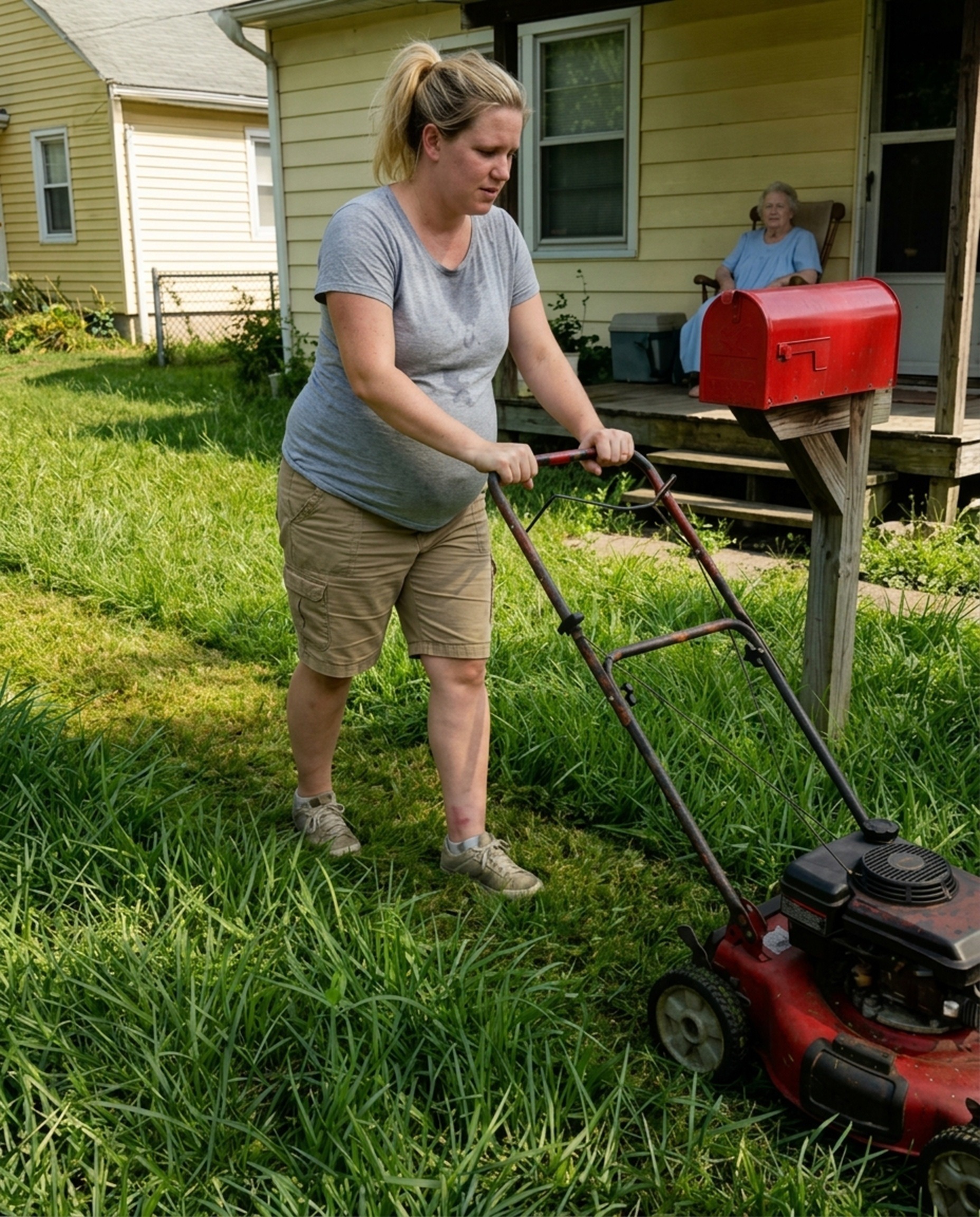
The grass in her front yard was nearly five inches high, thick with clover and crabgrass that had gone to seed. I set my feet, gripped the pull cord, and gave it a hard, steady yank.
The old engine coughed twice, spat a thin blue cloud of exhaust, and then roared into a rattling, uneven idle. The blue gas cap danced against the tank, vibrating so fast it became a blur.
I leaned my weight into the handle and pushed the machine forward into the first thick patch of green.
My lower back flared with a dull, familiar ache almost immediately, a heavy pull that made me slow my pace to a crawl. The baby remained quiet, a heavy warmth centered low in my belly, while I focused on keeping the machine straight along the edge of the gravel driveway.
Every few yards, I had to stop and tilt the deck to clear the wet grass that clogged the chute.
Clara did not move from the wooden steps, her yellow hat casting a wide shadow over her face, but I could feel her eyes following me. Every time I turned the mower near the maple tree, I caught her watching with an expression that was not just tired, but deeply sorrowful, as if she were looking at something already gone.
The air under the trees was completely still, trapping the heat and the sharp smell of gasoline close to the dirt. I worked in concentric squares, moving inward, the physical effort forcing the image of the red-bordered letter out of my mind for a few minutes.
By the time I reached the last narrow strip of grass near her porch, the front of my shirt was damp with sweat, and my thighs felt like lead.
I released the safety lever, and the sudden silence of the dead engine felt heavy, filled only by the distant hum of the highway.
Clara was already standing by the screen door when I pushed the quiet mower toward the side of the house. She held a metal tray with a tall glass of lemonade, the ice cubes clinking against the glass with a rapid, frantic rhythm.
As I walked up the three porch steps, I realized the clinking was not from her movement, but from the violent trembling of her fingers.
“Sit down, Nora,” she said, her voice dropping to a whisper as she set the tray on the small wicker table. “Please.”
I took the glass, the condensation instantly cooling my palm, and sat on the wicker bench while she sank back onto her cushioned chair. Her hands remained in her lap, tucked under her white cotton apron as if she were trying to hide the shaking.
“You did a beautiful job,” she said, looking out at the neat, pale green rows. “Arthur always said a manicured lawn keeps the world at bay.”
“It was overdue,” I said, taking a long drink of the cold, tart liquid. “I did not mind the work.”
“A young woman in your position should not have to carry the heavy end of the rope,” Clara said, her blue eyes fixing on my face with a quiet, unsettling intensity. “Where is that boy, Nora?”
The question hung in the hot air between us, landing with a weight that made me set the glass down on the metal tray.
I looked down at my lap, my thumbs tracing the seam of my maternity shorts, wishing I could find a convenient lie. The truth felt like a physical weight in my throat, dry and hard to swallow.