The grease on the frying pan did not want to come off under the lukewarm water faucet.
My father sat at the yellow Formica table with three pink invoices spread between his elbows. He did not look up when the iron skillet clattered against the porcelain sink.
“You missed two rafters on the corner of the Miller garage today,” he said.
I picked up the dish towel and began to dry my mother’s blue ceramic coffee mug. It had a small white scratch near the handle where her wedding ring used to graze the glaze.
“The wood was dry-rotted near the soffit,” I said.
“You do not decide what is rotten on my job sites,” he said.
He crossed his arms tightly over his chest and stared at the cracked plaster above the refrigerator. His voice carried that heavy, commanding weight that always filled the corners of the small kitchen on Piedmont Road.
“I have two more estimates to write tonight,” he said.
I set the blue mug on the second shelf of the cupboard, right where it had stayed for the last five years. My left hand went to my pocket, my thumb automatically rubbing the small, jagged scar on my palm from a loose roofing nail.
“We need forty bundles of three-tab shingles by tomorrow morning,” he said.
“The hardware store does not open until seven,” I said.
He tapped his thick index finger against the edge of the table. “Then you will be waiting in the truck at ten to seven.”
I walked out the back door without answering.
Nate Miller was waiting three houses down in his rusted sedan with the headlights turned off. The engine idle was rough, making the dashboard plastic rattle in the dark.
“Did you get it?” I asked.
Nate reached into his glove compartment and pulled out a long white envelope. He tapped his fingers rapidly against the plastic steering wheel, his eyes scanning the quiet street behind us.
“My cousin Otis said it came to his mailbox in Columbus on Tuesday,” Nate said.
He let out a short, nervous chuckle that died out quickly.
I slid the paper out of the envelope and held it under the dim orange light of the dome lamp. The letterhead read Columbus Technical Academy, showing a registration receipt for fifteen hundred dollars.
“That is every dollar you saved from the demolition work,” Nate said.
“It is paid,” I said.
“Your father thinks you are signing the new partnership papers with him next week,” Nate said.
I folded the receipt and put it into my back pocket.
“He still has the three judgments from the county court on his desk,” I said.
Nate put the car in drive and let it roll slowly toward the main road. “He is going to find out you are leaving, Leo.”
“Not tonight,” I said.
“Otis has a couch you can use for two weeks,” Nate said.
I looked at the dark houses passing by, my hand resting on the heavy envelope in my pocket.
The next morning, the asphalt lot of the Dayton hardware store was mostly empty. A cold wind blew a discarded plastic bag across the gravel.
My father stood by the tailgate of our flatbed truck, watching two teenagers load the forty bundles of shingles. He did not help them, keeping his arms crossed over his chest.
“The local bank manager asked about you yesterday,” he said.
“What did he want?” I asked.
“He wanted to know if you were staying in town to run the crew,” my father said.
He stepped closer, his shadow falling across the metal bed of the truck. His voice was low but carried across the quiet parking lot.
“I told him you were,” he said.
I lifted a bundle of shingles and swung it over the side rail. The rough paper scraped against my palm, right across my scar.
“We have thirty days to finish the Miller roof,” my father said.
“The deck needs to be completely replaced first,” I said.
“We do not have the budget for a new deck,” he said.
He grabbed my shoulder with a tight grip that did not feel like a father’s hand.
“A man who works under my name does not make plans behind my back,” he said.
I looked down at his dusty work boots, which were scuffed down to the gray leather at the toes.
“The shingles are loaded,” I said.
He let go of my shoulder and climbed into the cab of the truck without another word.
At midnight, the house on Piedmont Road was quiet except for the rhythmic, heavy footsteps upstairs. My father was pacing the floor of his bedroom, back and forth, from the window to the closet.
I sat on the edge of my mattress with a cardboard box between my feet.
The blue ceramic coffee mug sat on my desk next to my keys. I had taken it from the kitchen cupboard while the house was dark, wrapping it carefully in a gray wool sock.
The paper receipt from the Columbus trade school lay flat on the mattress.
“I made my choice and I paid the deposit myself,” I whispered to the empty room.
The pacing upstairs stopped directly above my head.
I slid the box under the bed, pushing it deep into the shadow of the dust ruffle.
The silence in the house grew heavy, the kind of quiet that felt like a storm holding its breath.
I stood up and walked toward the bedroom door.
My hand hovered over the brass doorknob as I listened for any sound from the hallway.
I decided to step into the kitchen and speak to my father the next morning.
The linoleum was cold under my socks when I stepped into the kitchen at six. My father sat at the table with a yellow legal pad, his pencil hovering over a column of old numbers from the Maple Street estimate. The coffee maker was ticking on the counter, but the pot was empty and dry.
“I paid the deposit for the Columbus trade school yesterday,” I said, keeping my voice flat and low. “I start in two weeks.”
He did not look up from the pad. He slowly drew a thick line under a row of figures, then set the pencil down exactly parallel to the yellow edge of the paper. The clock on the wall made a dry click every sixty seconds.
“You did what?” he said.
“I made my choice and I paid the deposit myself,” I said.
He stood up, his tall frame blocking the grey morning light from the kitchen window. He crossed his arms tightly over his chest, his jaw set so hard the muscle in his cheek twitched. His blue flannel shirt was frayed at the cuffs, showing the grey thermal shirt underneath.
“You have work here,” he said, his voice rising. “The siding job on Maple Street starts Monday. I need three men on the staging by seven.”
“I am going to Columbus,” I said.
He walked past me without another word, his shoulder clipping mine as he headed out the back door. The screen door bounced twice against the frame, then settled with a soft rattle.
I went back to my room and sat on the edge of the mattress. My green plastic storage bin sat in the corner, packed with my clothes, my laptop, and my mother’s things. Underneath my clean socks, I had hidden the white envelope containing my registration receipt for the trade school.
By three in the afternoon, the heat in the backyard was thick. I came around the side of the house after looking for my toolbox in the basement, and I stopped near the gravel driveway.
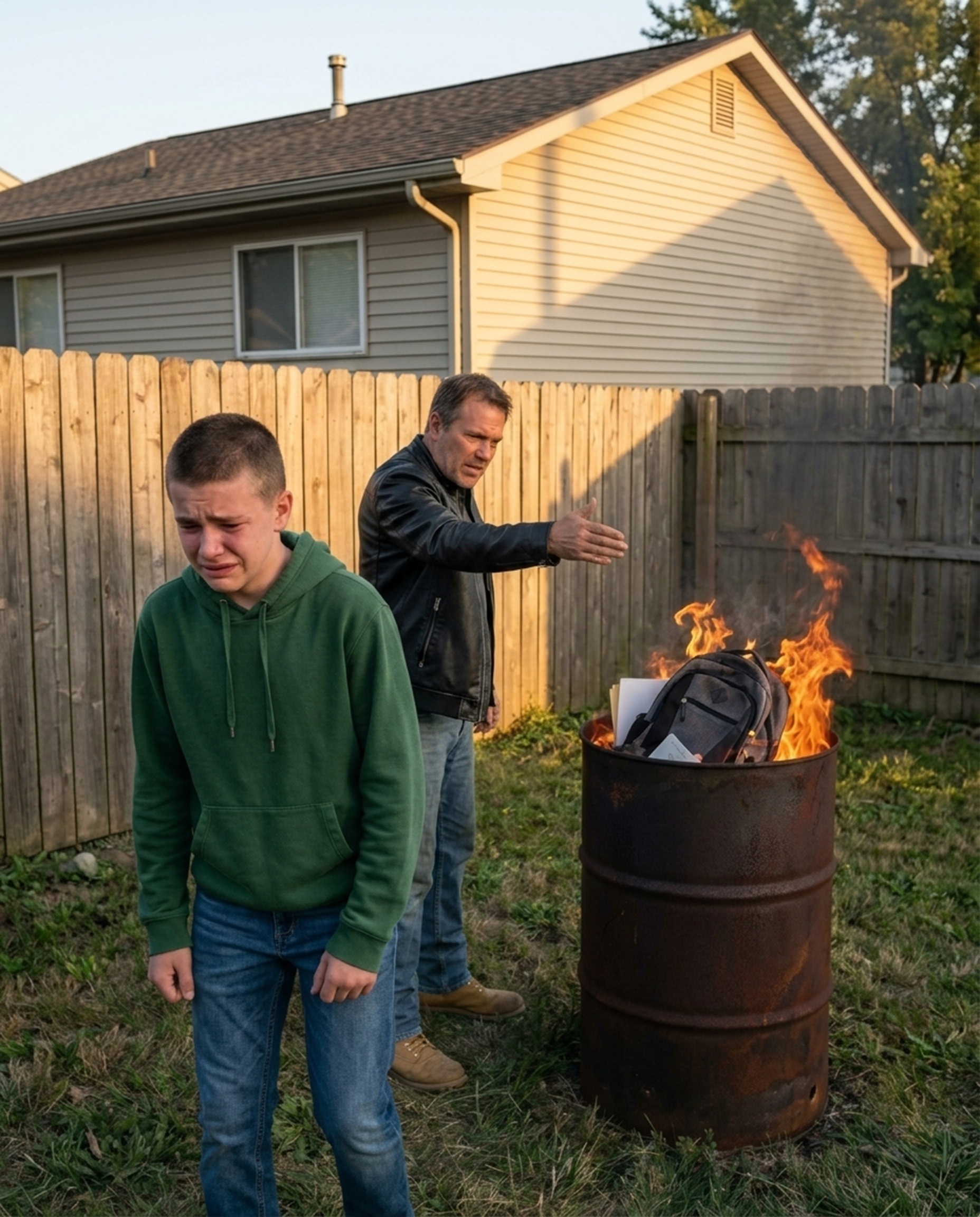
My father stood over the rusted oil drum we used for burning yard waste. A thin column of black smoke rose straight into the humid air, carrying the sharp, chemical stench of melting nylon and rubber.
My green storage bin was sitting on the grass, its lid cracked and thrown to the side. Most of its contents were already gone.
“What are you doing?” I asked, taking two quick steps toward him.
He did not answer. He used a piece of broken two-by-four to poke at something heavy inside the barrel, sending up a shower of orange sparks.
I saw the heel of my spare work boots charring in the embers. They were the cheap twenty-nine dollar pair I had bought at the farm supply store in May. Beside them, the keys of my old laptop were curling and turning black under the heat.
I reached for the bin to grab what was left, but he swung the timber down, cracking it against the metal rim of the drum. The vibration rattled through the wood and into the gravel under my feet.
“You want to be your own man,” he said, his voice loud and steady. “You can do it with what you carry.”
He reached into the bin and pulled out my mother’s blue ceramic mug. He held it by the handle for a second, his fingers rough and stained with dark grease.
“Leave that,” I said.