Part 1: The Promise I Never Questioned
My father’s last words have lived inside me for 12 years. I hear the weakness in his voice as he squeezed my hand and whispered, “Take care of your mother.” I promised without hesitation, never imagining that love could become invisible when everyone else grew comfortable watching me carry it.
Dad died 3 days later.
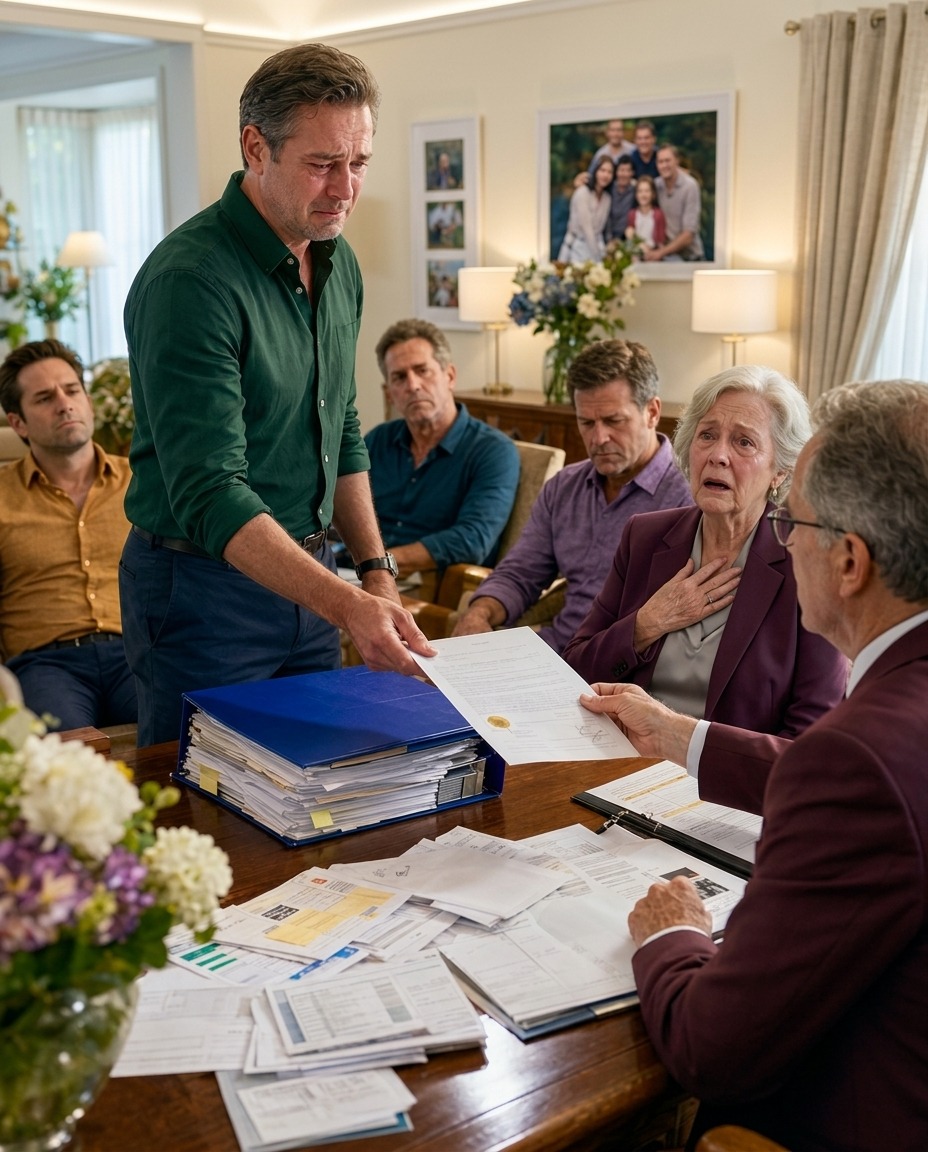
At the funeral, my brothers and I stood shoulder to shoulder while Mom trembled between us. There were 4 sons in our family, all close enough in age that strangers used to ask if we were twins. Dad had always believed that meant Mom would never be alone. He was wrong.
Within a year, my brothers were busy building their own lives. Michael moved 2 states away for work. David had 3 children and said money was always tight. Evan, the youngest, seemed permanently caught between jobs, girlfriends, and plans that never quite became reality. I stayed.
At first, helping Mom felt temporary. I covered her rent when Dad’s final medical bills swallowed what little savings remained. Then I paid the electric bill because winter had been unusually cold. I filled her refrigerator after noticing she had started skipping meals. When her prescription copay increased, I quietly added it to my monthly expenses.
One emergency became a routine.
Every month I transferred money into her account. I bought groceries, medications, clothing, household supplies, and gas. When the roof began leaking over the guest bedroom, I paid $9,400 to replace it. When the furnace died during a January cold snap, I covered $6,800 for a new system.
I drove her to every medical appointment I could.
Sometimes that meant leaving work before sunrise, driving 50 minutes to her house, taking her to a specialist across town, waiting through appointments, bringing her home, then returning to the office after everyone else had left.
I never complained to her.
Whenever she apologized, I smiled.
“It’s okay, Mom. It’s what Dad wanted.”
Those words became my shield.
They made exhaustion sound noble. They made resentment feel selfish. They allowed everyone else to believe I was doing exactly what I wanted and needed nothing in return.
My accountant was the only person who kept telling me to document everything.
“You’re spending too much not to keep records,” he said. So I did.
I saved receipts in labeled envelopes. I printed bank transfers. I kept cancelled checks, medical invoices, contractor bills, pharmacy statements, insurance correspondence, and handwritten notes showing what each payment covered.
I never imagined showing any of it to my brothers.
The records were for taxes, accounting, and my own memory.
After 12 years, the total reached $156,000.
I remember staring at that number on a spreadsheet and feeling strangely detached from it. It looked enormous on a screen, but in real life it had disappeared in pieces: $150 here, $700 there, $2,000 for repairs, $4,300 for dental work.
Then, one Tuesday morning, my phone rang. It was Mom’s neighbor. “Your mother collapsed.”
By the time I reached the hospital, doctors were already preparing her for emergency surgery.
I called all 3 brothers from the hospital hallway. Michael said he would try to come that weekend. David said one of his children had a school event. Evan promised to call Mom later. I stood there holding her purse and insurance card, listening to excuses while nurses rushed past me, and understood that once again, there was nobody else coming for us.
I truly had no idea what waited inside.
And before the night was over, I learned exactly how much my promise to Dad was still going to demand.
Part 2: When Equal Suddenly Felt Cruel
The surgery lasted almost 6 hours.
I sat alone beneath fluorescent lights, drinking terrible coffee from a paper cup and answering questions about medications, allergies, insurance, and emergency contacts. Every form seemed to ask for information I knew because I had been the one managing Mom’s life for years.
When the surgeon finally appeared, his expression was tired but calm. “She made it through.”
My knees almost gave out.
Mom would need weeks in the hospital and months of rehabilitation. Insurance covered most of the surgery, but not everything. There were deductibles, specialists, therapy sessions, medications, equipment, home modifications, and charges nobody had mentioned before treatment began.
The uncovered portion eventually came to almost $45,000.
I called my brothers again.
This time, I did not ask whether they could visit. I asked for money.
Michael sighed. “I’m struggling right now. Give me a few months.”
David said, “I’ve got 3 kids. You know what that costs.”
Evan told me, “I’ll help later when work picks up.”
Later became the family word for never.
I waited 2 weeks before paying the first major bill. I kept thinking one of them might call and say he had found $2,000, $5,000, anything. Nobody did.
So I paid every dollar.
The money was only part of it.
I slept in hospital chairs when Mom was frightened. I argued with an insurer for 3 hours over a denied rehabilitation claim. I learned how to clean her incision, organize 9 medications, measure her blood pressure, and help her stand without making her feel helpless.
When she entered rehabilitation, I brought food because she hated the meals.
When she came home, I installed grab bars, moved furniture, and arranged my work schedule around therapy appointments.
Some nights I drove home so exhausted that I sat in my garage for 20 minutes before finding the energy to walk inside. Nobody saw those moments.
My brothers called Mom occasionally. They sent flowers once.
They visited on holidays and asked me for updates as though I were a nurse they had hired. Still, I said nothing.
I had made Dad a promise.
Six months after surgery, Mom crossed her living room using a cane and no assistance.
She turned toward me, smiling through tears. “Look at me.”
I clapped like a child.
That evening, after I helped her into bed, she took my hand.
“I don’t know what I would have done without you.”
“You would have figured it out.”
“No,” she said. “Your father would be proud of you.”
That sentence made every sleepless night feel worthwhile.
I thought the hardest part was behind us.
Then, one Sunday, Mom invited all 4 of us to dinner.
Michael came from out of town. David brought his wife. Evan arrived late, carrying wine he knew Mom could not drink.
After dessert, Mom folded her napkin carefully and smiled.
“I have some good news.”
She told us she had finished updating her will.
“My estate will be divided equally,” she said. “Each of my 4 sons will receive 25%.” Everyone became quiet.
I waited for her to mention the $201,000 I had spent. She never did.
Evan leaned back in his chair, smiled at me, and said, “Fair is fair.”
I looked around the table at my brothers. They knew about the roof, the hospital, the bills, the appointments, and the years I had rearranged my life. Yet none of them looked surprised. To them, Mom’s announcement was not unfair. It was simply convenient. And apparently, convenience had become our definition of family.
That was the moment something inside me finally broke.