
“…hoping to spot something of yours,” Julian finished, his voice cracking over the phone. “Anything. A book with your name in it. A jacket I remembered. I recognized your handwriting on the outside of the box the second they put it on the shelf.”
I couldn’t speak. The kitchen around me felt like it was spinning, the afternoon light suddenly too harsh, too bright. Thirty years of a carefully constructed reality was unraveling with every word he spoke.
“Meet me,” he pleaded. It wasn’t a demand; it was a beggar’s prayer. “Please, Chloe. Just let me look at you. The diner on 4th. I can be there in ten minutes.”
I don’t remember agreeing. I only remember hanging up, staring at my reflection in the dark microwave glass, and realizing I was crying so hard my chest physically ached. I grabbed my keys, didn’t bother changing out of my sweatpants, and drove to 4th Street blindly, operating on muscle memory and adrenaline.
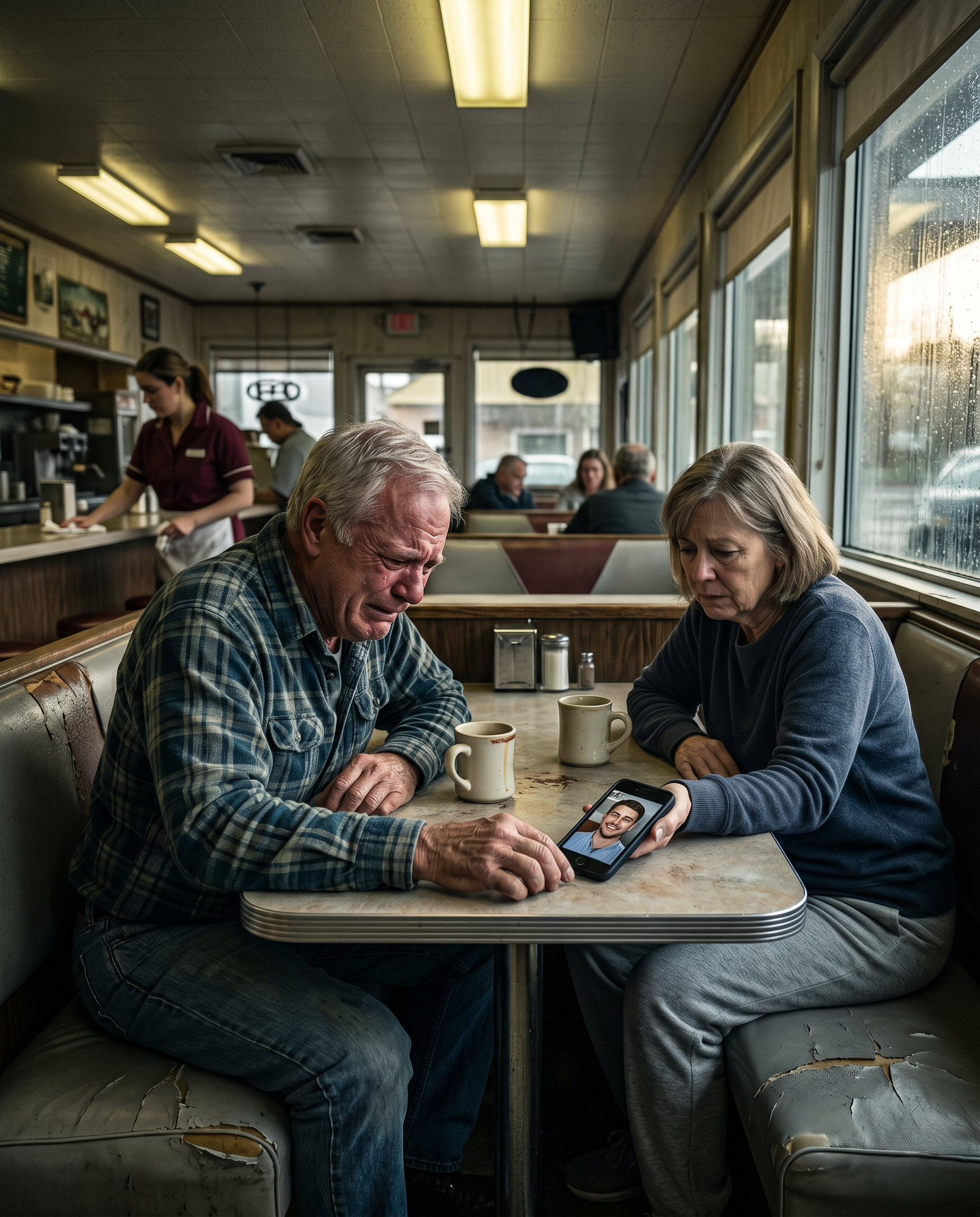
The diner was mostly empty, smelling of stale coffee and industrial bleach. I saw him immediately. He was sitting in the back corner booth, staring at the scarred laminate table. The thick, dark hair I remembered from college was entirely silver now. He wore a faded flannel shirt, his shoulders broader but hunched, carrying a weight I couldn’t understand until today.
When I slid into the booth across from him, he looked up. His eyes—the exact same hazel eyes my son looks at me with every time we FaceTime—were bloodshot and swimming in tears.
“You didn’t go to Seattle,” he said softly. It was a statement, not a question, but it held thirty years of grief.
“I’ve lived in the same three-mile radius since the day you left for London,” I replied, my voice shaking.
Julian covered his face with his hands. The rugged, calloused hands of a man who worked with antiques, not the smooth hands of the corporate executive he was supposed to become. He took a ragged breath and looked back at me.
“I hated London. I hated the job. I lasted eight months before I broke my contract and flew back. I went straight to your apartment, but there was a different name on the mailbox. I panicked.” He traced a scratch on the table. “I found Rachel at her retail job. I begged her to tell me where you were. She looked at me with this… this pity. She said you were pregnant, but that it was the economics guy’s baby. She said you guys got married fast and moved to Seattle for his job. She told me to leave you alone, that you were finally happy.”
The betrayal hit me like a physical blow to the ribs. Rachel. My older sister, who always resented me. Rachel, who was struggling financially at the time and living on my couch rent-free. If Julian had come back, if he had claimed me and the baby, I would have moved out. I would have stopped supporting her. She traded my son’s father for a free place to sleep.
“Why didn’t you try to find me anyway?” I asked, hating how small my voice sounded.
“I did,” Julian insisted, pulling his wallet out. From behind his driver’s license, he slid out a folded, brittle piece of paper. It was a receipt from a private investigation firm dated 1997. “I paid this guy five thousand dollars I didn’t have. But he was looking for a Chloe married to a guy named Mark in Washington State. Of course he never found you. You were a ghost.”
We sat in silence as a waitress slapped two mugs of coffee down between us, oblivious to the decades of trauma bleeding out onto the table.
“His name is Liam,” I finally said into the quiet.
Julian’s head snapped up. “Liam,” he repeated, testing the syllables like they were fragile. “Liam. You named him after my grandfather.”
“You told me once you wanted a son named Liam. I never forgot.”
The tears spilled over his eyelashes then, catching in the deep lines around his mouth. He didn’t bother wiping them away. “What is he like? Please, Chloe. Tell me everything. Do not leave a single detail out.”
For the next two hours, the diner faded away. I told him about the ear infections when Liam was two. I told him about the time Liam broke his arm falling out of a neighbor’s oak tree at age nine. I talked about how Liam struggled with math but could build intricate, sprawling cities out of spare cardboard boxes, which eventually led to his engineering degree.
I told Julian how Liam would ask about his father. How I had fed my son a sanitized, half-true narrative: Your dad got an amazing job overseas. We were too young. We just went separate ways. I never told Liam about the Polaroid. I never told him I sat outside his father’s apartment building too terrified to go inside.
“Does he hate me?” Julian asked, his voice barely above a whisper. “Does he think I abandoned him?”
“No,” I lied gently. “He just thinks it wasn’t meant to be.” But the truth was, Liam carried a quiet, unspoken wound. You don’t grow up fatherless without developing a callous over the empty space where a dad should have been.
“Can I see him?” Julian asked. “Not in person. Just… a picture.”
My hands trembled as I unlocked my phone. I opened my favorites folder and clicked on a photo from last Christmas. Liam was standing by the tree, his arm wrapped around his fiancée, flashing that crooked, slightly left-leaning smile. He was wearing a dark green sweater, his hair messy, looking so much like the man sitting across from me that it was haunting.
I pushed the phone across the table.
Julian stared at the screen for a long, agonizing time. His chest heaved. He reached out, his thick finger hovering just millimeters above the glass, tracing the outline of his son’s face without actually touching it. He made a sound—a low, broken noise in the back of his throat—and buried his face in his arms right there on the diner table, weeping with the kind of absolute devastation that breaks a person in half.
I didn’t reach across to comfort him. I couldn’t. I was drowning in my own ocean of regret. If I had just gotten out of the car. If I had just walked up those three flights of stairs thirty years ago and handed him that photograph. We wouldn’t be sitting in a rundown diner, mourning the ghost of a life we were supposed to share.
When Julian finally sat up, his eyes were red and swollen. He pushed the phone gently back to my side of the table.
“He’s beautiful,” he said. “He looks strong.”
“He is.”
Julian wiped his face with a paper napkin. “I won’t blow up his life, Chloe. I swear to God. I won’t suddenly appear and demand to be his father. I lost that right when I got on that plane, no matter what Rachel lied about.”
“Julian—”
“No,” he interrupted, his tone firming up. “He’s getting married. He has a life. You built that for him. You did that. But…” He swallowed hard. “I own the antique shop on 8th. I live in the apartment above it. I’m not leaving. I just… I want to be in the same city as him. I just want to know that when the wind blows through Chicago, it might be heading this way, coming from where he is.”
We walked out to the parking lot together as the rain finally stopped, leaving the asphalt slick and reflective. We stood awkwardly by my car, two strangers who shared the most intimate bond humanly possible.
He didn’t hug me. He just looked at me with those familiar hazel eyes.
“Thank you,” he said. “For keeping him. And for not throwing away the record.”
I watched him walk down the street, his shoulders a little less hunched than before. I got into my car, locked the doors, and sat in the silence. I picked up my phone and dialed my son’s number.
It rang three times before Liam answered. “Hey Mom, everything okay?”
I closed my eyes, listening to the pitch of his voice, hearing the echo of the man who had just walked away.
“Hey, sweetie,” I said, my voice finally steady. “Do you have some time to talk? There’s a story I need to tell you. From a long time ago.”