
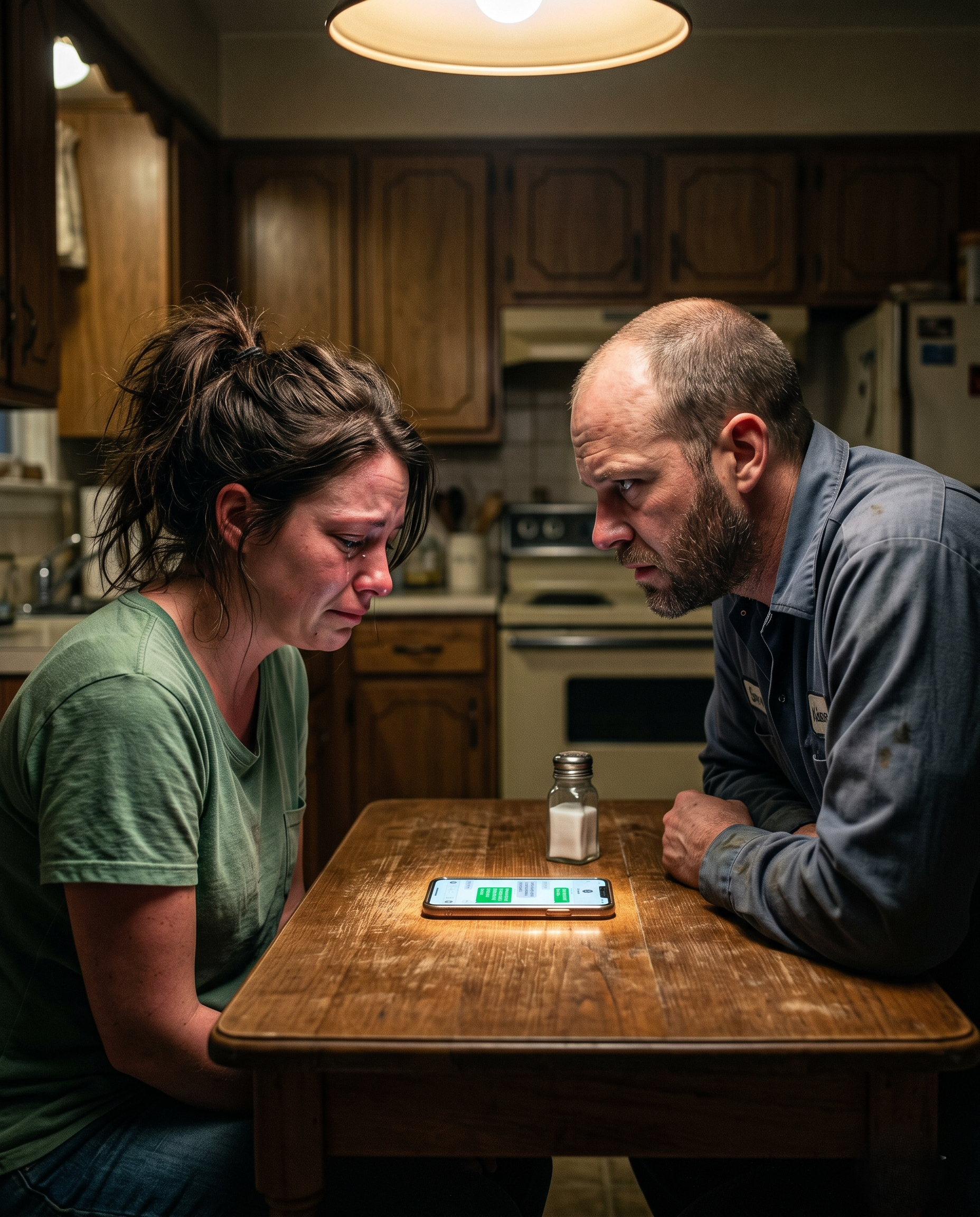
“Before you leave me, you need to know something,” Mark said, his voice dropping to a panicked whisper as he stared at the screen of my phone.
He didn’t look at me. He just stared at the screen, right next to the chipped ceramic salt shaker we’d used for a decade. The light from our stove cast long, ugly shadows across the kitchen table.
For 3 years, Mark told me he was going to my sister Karen’s house every Friday night. He said he was fixing her leaky kitchen sink. I believed him because I trusted him. He was my husband.
I even packed him leftover casserole in Tupperware so he wouldn’t have to cook after a long day at the shipping warehouse. I felt bad that he had to spend his Friday nights doing hard labor.
Then, yesterday afternoon, our 8-year-old daughter Lilly looked up from her coloring book. She was eating apple slices at the kitchen island.
“Daddy was at Aunt Karen’s house again,” she said casually.
My stomach dropped. Yesterday was a Thursday. Mark had told me he was working late to help with the inventory count.
“Are you sure, sweetie?” I asked, trying to keep my voice light.
“Yes,” she said, swinging her legs. “I saw his blue Buick in her driveway when Grandma drove me past to go to the park.”
I didn’t say anything to Lilly. I didn’t want her to see the panic in my face. But a cold, heavy weight settled deep in my chest.
I need to back up for a second. To understand why this hurt so badly, you have to know about the plumbing drama. It started on a Friday in October 3 years ago.
Karen called our house crying. She had just finalized her divorce from her wealthy husband, and she was living in a modest ranch home on Oak Street. She said her kitchen sink was backing up and she couldn’t afford a real plumber.
Mark immediately volunteered to help. He was always the quiet, reliable type. He went to his garage, packed his gray metal toolbox, and drove over.
He came home 3 hours later, smelling like pipe grease and copper. He told me the pipes were ancient. He said they would need weekly maintenance until we could afford to help her replace them.
I thought he was being a wonderful brother-in-law. I felt proud to be married to a man who cared so much about family.
Every Friday, the routine was the same. Mark would come home from the warehouse, grab his toolbox, and head to Karen’s.
It became a joke in our family. At Thanksgiving, my aunt even asked if Karen’s house was built on a swamp. Mark just smiled his quiet, Midwestern smile and said old copper pipes are a nightmare.
But over those 3 years, things changed in our own home. Mark stopped looking at me when I spoke. He started keeping his phone face down on the nightstand.
When I bought a new dress for our anniversary, he didn’t even notice. He just ate his dinner in silence, staring at the wall.
I thought he was just tired. I thought the stress of his job was getting to him. I tried to make things easier for him. I kept the house quiet. I clipped coupons to save money.
And every Friday, I kept the salt shaker clean, wiped down the table, and waited for him to come home from “fixing the sink.”
That chipped ceramic salt shaker was a silly thing. I bought it at a Toledo thrift store for fifty cents when we first got married. It had a tiny chip on the rim, but I loved it anyway. To me, it represented our simple, comfortable life.
Now, sitting at the kitchen table, that salt shaker looked like a joke.
On Friday morning, I decided I couldn’t ignore Lilly’s comment. I waited until Mark left for work. Then, at 6 PM, I told our neighbor Mrs. Gable that I had to run some errands and asked if she could watch Lilly for an hour.
I got into my old Chevrolet and drove toward Karen’s neighborhood. The drive felt longer than usual. My hands were shaking so badly on the steering wheel that I had to grip it until my knuckles were white.
When I turned onto Oak Street, my eyes immediately searched for Mark’s blue Buick LeSabre. It wasn’t in Karen’s driveway.
For a brief second, I felt a rush of relief. I thought Lilly had made a mistake. I almost turned the car around to go home.
But then I noticed the garage door. It was completely shut. Karen never parked her car in the garage. She used it for storage.
I parked my car a block away, near the local Methodist church. I walked back to Karen’s house on foot, my boots squelching in the wet grass of her side yard.
I walked around to the back of the house. The kitchen light was on, casting a bright yellow square onto the damp patio.
I took a deep breath and looked through the kitchen window.
They weren’t working on any plumbing. There was no toolbox in sight.
Instead, there was a bottle of expensive white wine on the counter. Mark and Karen were sitting at her small kitchen table. He was holding her hand, laughing at something she said. It was a genuine, happy laugh. I hadn’t seen him laugh like that in years.
Then, he leaned over and kissed her.
My body went completely rigid. I felt a physical sickness rise in my throat. I wanted to scream, to kick the door down, to break the glass. But something colder and calmer took over.
I took my phone out of my pocket. My fingers were trembling, but I managed to unlock the camera.
I took 6 clear photos. The flash was off, so they didn’t see me. I captured everything. The wine, the holding of hands, the kiss.
I walked back to my car in silence. The drive home was a blur. I don’t even remember the route I took. My brain was operating on pure survival mode.
When I got home, I picked up Lilly from Mrs. Gable’s house. I made her dinner, tucked her into bed, and read her a story. My voice sounded completely normal to her. I don’t know how I managed that.
After she fell asleep, I went downstairs to the kitchen. I set the table for two. I placed the chipped ceramic salt shaker in the exact center.
At 10 PM, the front door clicked open. Mark walked in. He looked tired, carrying his gray metal toolbox. He set it down by the door with a heavy sigh.
As he walked past me, I caught the scent. It wasn’t pipe grease. It was her expensive lavender body wash.
“How was the sink?” I asked, my voice terrifyingly calm.
“The same,” he said, rubbing his neck. “The trap is rusting out. I’ll have to go back next week to finish it.”
I didn’t answer. I just unlocked my phone, opened the gallery, and slid the device across the wooden table. It slid right next to the salt shaker.
Mark looked down. His eyes widened. The color drained from his face so fast he looked green. He opened his mouth, but no sound came out.
“Sarah, I can explain,” he stammered, his hands shaking as he touched the screen.
“There’s nothing to explain, Mark,” I said. “I saw you. I was standing in the yard.”
He looked up, his eyes wide with panic. And that is when he dropped his pathetic defense.
“Karen came to me first,” he whispered. “Three years ago. She found out something about you. She said if I didn’t do what she wanted, she’d destroy your life.”
I stared at him, my brow furrowing. “What are you talking about?”
“She found the old medical files,” Mark said, his voice desperate. He was leaning forward, trying to grab my hand, but I pulled away. “From Toledo General. From when we first got married. The ones about your stay in the psychiatric ward after Lilly was born. She said she’d send them to the school board. You’d lose your job at the school, Sarah. And she said she’d tell Lilly you were a monster.”
I looked at him, and for a second, I couldn’t breathe. Not because of the secret. But because of his absolute stupidity.
When Lilly was born, I suffered from severe postpartum depression. It was the darkest period of my life. I had spent two weeks in a specialized clinic to get help. I had never hidden this. It was a medical crisis, not a crime.
“Mark,” I said quietly, my voice dropping to a dangerous whisper. “The school district did a full medical background check on me when I was hired ten years ago. They have my complete file. They don’t care about a postpartum depression stay from nine years ago. It’s legally protected health information.”
He blinked, confused.
“And as for Lilly,” I continued, “I sat down with her last summer. I told her that after she was born, Mommy’s brain got sick, and some nice doctors helped me get better. She gave me a hug and asked if she could have a cookie. She already knows.”
Mark’s jaw went completely slack. He sat there, staring at me, the realization finally hitting him. The weapon Karen had been using to “blackmail” him was completely useless.
But I wasn’t done. I had spent the entire evening before he came home looking through our finances online.
“And what about the money, Mark?” I asked, leaning forward.
He flinched. “What money?”
“The four hundred dollars a month you’ve been transferring from our joint savings account to Karen’s personal account for the last three years,” I said. “Was that blackmail too? Or were you just paying her rent while she spent her divorce settlement on lavender perfume and new shoes?”
He had no answer. He just looked down at his lap, his shoulders slumped in defeat. He had spent three years playing the role of a tragic hero protecting his wife, when in reality, he was just a coward who wanted an excuse to betray me.
I stood up from the table. My hand brushed against the chipped salt shaker. I picked it up, looked at the tiny crack, and then dropped it into the trash can next to the sink. It made a sharp, clinking sound as it hit the plastic liner.
“Pack your things, Mark,” I said. “You have twenty minutes. If you’re not out by then, I’m calling the police.”
“Sarah, please,” he begged, tears finally welling in his eyes. “This is my house too.”
“No, it isn’t,” I said calmly. “My parents left this house to me in their will. It’s solely in my name. Your name isn’t on the deed. My lawyer, Martin, already confirmed that tonight.”
He looked at me, and he finally realized he had no leverage left. He walked down the hall and started packing his clothes into a duffel bag.
I stood in the kitchen, waiting. The silence in the house was heavy, but it didn’t feel lonely anymore. It felt clean.
After Mark left with his bags, I didn’t cry. I sat at the empty table and called my mother.
My mother is a traditional Midwestern woman. She doesn’t like drama. But she loves her children. When I told her what I had found, and what Karen had done, she didn’t scream. She was quiet for a long moment.
“The family dinner is this Sunday,” my mother said softly. “At the Golden Grille. You bring Lilly. I’ll handle the rest.”
On Sunday afternoon, the family gathered at the Golden Grille, a local family diner we had been going to for thirty years. My aunts, my uncles, and my cousins were all there, sitting around a long, vinyl-booth table.
Karen was already there when I arrived. She was wearing a new silk blouse and had her hair done. She looked beautiful, and she smiled at me as I walked in. It was a smug, victorious smile. She thought Mark was still her secret keeper.
She didn’t know Mark was currently sleeping on a cot in his coworker’s basement.
My mother waited until everyone had ordered their food. The waitress cleared the appetizer plates, leaving a quiet lull in the conversation.
My mother stood up. She took a manila envelope out of her purse and placed it on the table right in front of Karen.
“What’s this, Mom?” Karen asked, her smile faltering slightly.
“Open it,” my mother said. Her voice was steady, the voice of a matriarch who had raised four children on a farm and didn’t tolerate rot.
Karen opened the envelope. Inside were the 6 photos I had taken through her kitchen window, along with three years of bank statements showing the monthly transfers from my savings account.
Karen’s face went completely white. She looked at the photos, then at me, then at our mother.
“Mom, this is a misunderstanding,” Karen stammered, her voice rising in panic. “Mark was just helping me. I was lonely, and I didn’t have anyone…”
“You took your sister’s husband,” my mother said, her voice carrying across the quiet dining room. Several people at nearby tables turned to look. “And you took her money. You used her past struggles to blackmail a weak man.”
My Aunt Linda gasped, reaching for the photos. Within two minutes, the envelope was passed down the table. My uncles shook their heads. My cousins looked at Karen with disgust.
“You are no longer welcome in my home, Karen,” my mother said. “And you are no longer welcome at this table. Get up.”
Karen looked around the table, searching for an ally. But she found nothing but cold, hard stares. She stood up, her expensive heels clicking loudly on the linoleum floor, and ran out of the restaurant, leaving her purse behind.
My uncle Jerry picked up her purse and handed it to the waitress. “She won’t be needing dessert,” he said flatly.
We finished our dinner. We talked about Lilly’s school, my aunt’s garden, and the upcoming county fair. We didn’t mention Karen again.
That was six months ago.
Mark’s lawyer tried to fight for a portion of my retirement savings during the divorce proceedings, but once my lawyer presented the bank statements showing the unauthorized transfers to Karen, they settled quickly. Mark walked away with his Buick, his toolbox, and nothing else.
I bought a new salt and pepper shaker set last week. They are bright yellow, shaped like little lemons. They don’t have any chips or cracks.
Yesterday, Lilly and I were in the kitchen making cookies. She was covered in flour, laughing as she tried to lick the spoon.
I looked at the lemon salt shaker sitting on the clean counter. The sun was coming through the window, warming the room.
I don’t know what the future holds, but for the first time in three years, the water in my house runs perfectly clear.