
There are moments as a parent when fear arrives suddenly—sharp, overwhelming, and impossible to ignore.
That night was one of them.
It had been my daughter’s first time staying overnight at her stepmom’s house. Five years old—still so small, still so attached to the familiar rhythms of home. I had prepared her as best as I could. Reassured her. Smiled through my own uncertainty.
“You’ll have fun,” I told her.
And I wanted to believe it.
But when she came back, something was wrong.
I could see it immediately.
She wasn’t just tired. She wasn’t just quiet.
She was… shaken.
Tears welled up in her eyes before she even made it fully inside. Her small hands clung to her bag like it was the only thing grounding her.
“What happened?” I asked gently.
No answer.
“Did something go wrong?”
Silence.
She turned away, her face closing off in a way that didn’t belong to a child her age. She refused dinner. Refused to talk. Refused even the small comforts she usually ran toward without hesitation.
And that’s when the fear started to grow.
Because when a child can’t explain what’s wrong, your mind does it for them.
And it rarely chooses the best possibilities.
I called my ex.
Once.
Twice.
Again and again.
No answer.
Each unanswered call made the silence louder, heavier, more threatening. I left messages. Sent texts. Watched the screen, hoping for any sign that he would respond.
Nothing.
And that’s when panic took over.
Because there’s a particular kind of helplessness that comes from not knowing if your child is safe—or worse, not knowing what they might have gone through when you weren’t there.
I couldn’t sit still.
So I drove.
The streets felt longer than usual, the distance stretching in a way that made every second feel delayed, as if time itself was working against me.
When I arrived, the house was empty.
No lights.
No cars.
No answers.
I stood there for a moment, staring at the door, feeling the weight of everything I didn’t know pressing down on me.
And in that moment, my mind went everywhere.
Every possibility.
Every fear.
Every worst-case scenario that a parent tries not to think about—but can’t stop once it starts.
That night, sleep didn’t come.
Not really.
I lay there, listening for any sound from my daughter’s room, replaying the evening over and over again. Her silence. Her tears. The way she refused to explain.
I wondered if I had made a mistake.
If I had trusted too easily.
If I had missed something important.
Morning didn’t bring clarity.
Just exhaustion.
And a quiet determination to figure out what had happened.
She was still withdrawn. Still quiet. Still holding onto whatever she had experienced like it was something she couldn’t—or wouldn’t—share.
So I did the only thing I could think of.
I looked for clues.
Not out of invasion.
But out of concern.
Her small bag sat near the door, exactly where she had dropped it the night before. It looked ordinary. Nothing out of place.
But something told me to check.
I opened it carefully.
And that’s when everything changed.
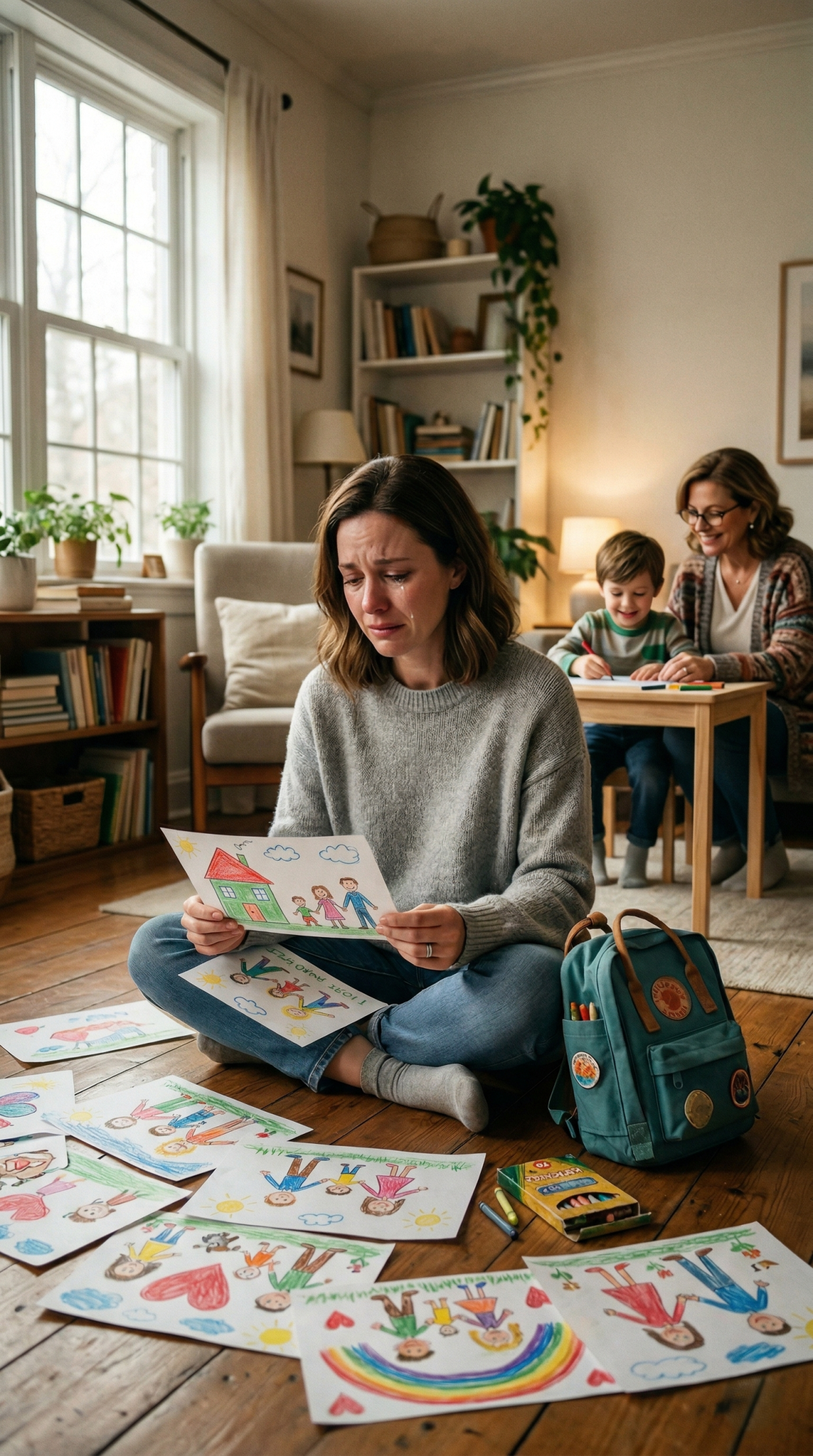
Inside, tucked neatly between her clothes, was a small stack of papers.
Drawings.
Folded carefully, as if they mattered.
As if they were meant to be kept safe.
I picked them up slowly, unsure of what I was about to find.
And then I saw the note.
Her stepmom’s handwriting.
Clear. Calm. Intentional.
“She was sad about missing you. We spent the afternoon drawing all the things she loves about Mommy’s house so she could take them back with her.”
For a moment, I didn’t move.
I just read it again.
And again.
Letting the words settle.
Letting them replace the fear that had filled my mind for hours.
And then I looked at the drawings.
Crayon lines. Bright colors. The kind of imperfect, beautiful art that only a child can create.
There was our kitchen—slightly crooked, full of color, filled with details only she would notice.
There was our dog—drawn with exaggerated features, somehow both inaccurate and completely recognizable.
And then there was me.
A simple drawing, full of warmth. My favorite dress—captured in uneven lines but unmistakable in meaning.
It wasn’t just a picture.
It was memory.
It was comfort.
It was home.
And suddenly, everything made sense.
She hadn’t been hurt.
She hadn’t been scared in the way I feared.
She had been sad.
Missing me.
Struggling with the newness of being somewhere else, away from everything she knew.
And instead of ignoring that feeling…
Instead of dismissing it…
Her stepmom had met her there.
Sat with her.
Helped her process it.
Turned that sadness into something she could hold onto.
Something she could carry back with her.
And then there was the last part of the note.
“Loving someone is not a competition. We can take turns, you’ll always be her mom.”
That’s when the tears came.
Not from fear.
Not from panic.
But from something deeper.
Relief.
Gratitude.
And something I hadn’t expected—respect.
Because co-parenting is rarely easy.
It’s complicated. Emotional. Full of unspoken tensions and uncertainties.
There’s always a part of you that wonders.
How will they treat your child?
Will they understand them the way you do?
Will they respect the bond you share?
And sometimes, if you’re honest, there’s fear.
Fear of being replaced.
Of becoming less important.
Of losing something that feels irreplaceable.
But in that moment, sitting on the floor with those drawings in my hands, I realized something important.
Love doesn’t divide.
It expands.
It makes room.
And what her stepmom had done—it wasn’t an act of competition.
It was an act of care.
Not just for my daughter.
But for me, too.
Because she could have handled that moment differently.
She could have distracted her. Ignored the tears. Told her to adjust, to be strong, to stop missing home.
But she didn’t.
She acknowledged it.
Honored it.
And gently reminded her that loving one home doesn’t mean losing another.
That she could belong in both places.
That she didn’t have to choose.
And that I…
Would always be her mom.
That kind of understanding isn’t loud.
It doesn’t announce itself.
But it changes things.
It shifts something fundamental.
Because trust isn’t built through words alone.
It’s built through moments like this.
Small, quiet, meaningful actions that show you who someone really is.
And in that moment, everything between us changed.
Not instantly.
Not perfectly.
But enough.
Enough to replace fear with trust.
Enough to replace tension with respect.
Enough to begin something new.
Because maybe co-parenting isn’t about being perfect.
Maybe it’s about showing up in the moments that matter.
Choosing kindness when it’s easier to choose distance.
Choosing understanding when it’s easier to assume the worst.
And realizing that sometimes, the people you worry about the most…
Are the ones quietly doing their best to protect what matters most to you.