
Some evenings begin with warmth, familiarity, and the quiet hope of connection.
That night was supposed to be one of them.
I had spent the afternoon preparing dinner, moving through the kitchen with the kind of rhythm that comes from years of habit. Chopping, stirring, tasting—small, practiced motions that carried more meaning than they seemed. Cooking, for me, was never just about the food. It was about creating a space where people could gather, relax, and feel cared for.
When my son told me he and his wife would be coming over, I felt that familiar sense of anticipation. It had been a while since we had all sat down together, and I wanted everything to feel just right.
Not perfect—just welcoming.
My daughter-in-law had never been one for cooking. That wasn’t a secret. In fact, she had always been open about it, often joking about how she avoided the kitchen whenever possible. I never judged her for that. Everyone expresses care differently.
So when she offered to bring a pie, I was surprised.
But also… touched.
It felt like an effort. A small one, perhaps, but meaningful. A gesture that said she wanted to contribute, to participate, to be part of the evening in her own way.
“Are you sure?” I had asked gently.
She smiled, a little too quickly.
“Of course,” she said. “I’ve got it covered.”
I didn’t question it.
Looking back, I wonder if I should have.
Dinner itself was pleasant. Comfortable. We talked about everyday things—work, routines, small updates that fill the gaps between visits. There was laughter, the kind that comes easily when people are trying to reconnect.
And then came dessert.
She brought out the pie with a quiet confidence, placing it on the table as if presenting something she had worked hard on.
It looked fine.
Nothing about it raised suspicion. The crust was intact, the filling set, the appearance completely ordinary.
If anything, it looked… store-bought.
But that thought passed quickly. Not because it didn’t matter, but because it didn’t feel important.
What mattered was the gesture.
We each took a slice.
The first bite didn’t taste remarkable—but it wasn’t immediately alarming either. Slightly off, perhaps. A faint bitterness beneath the sweetness. But subtle enough to dismiss.
Sometimes desserts just don’t turn out perfectly.
No one said anything.
We finished our slices, moved on, and continued the evening as usual.
Until the discomfort started.
At first, it was easy to ignore. A slight uneasiness. A heaviness that didn’t quite belong.
But it didn’t fade.
It grew.
Within an hour, both my husband and I were feeling it—something distinctly wrong. Nausea, dizziness, the unmistakable sense that whatever we had eaten wasn’t sitting right.
The evening ended earlier than expected.
They left, concerned but unaware of the cause, and the house returned to silence.
I told myself it was probably nothing.
Something mild. Something temporary.
But as I stood up to get a glass of water, still feeling unsettled, something pulled me back toward the kitchen.
Maybe it was instinct.
Maybe it was curiosity.
Or maybe it was something deeper—a quiet need to understand.
The dishes were still there, remnants of the evening not yet cleared. Plates, utensils, small signs of what had just taken place.
And then I saw it.
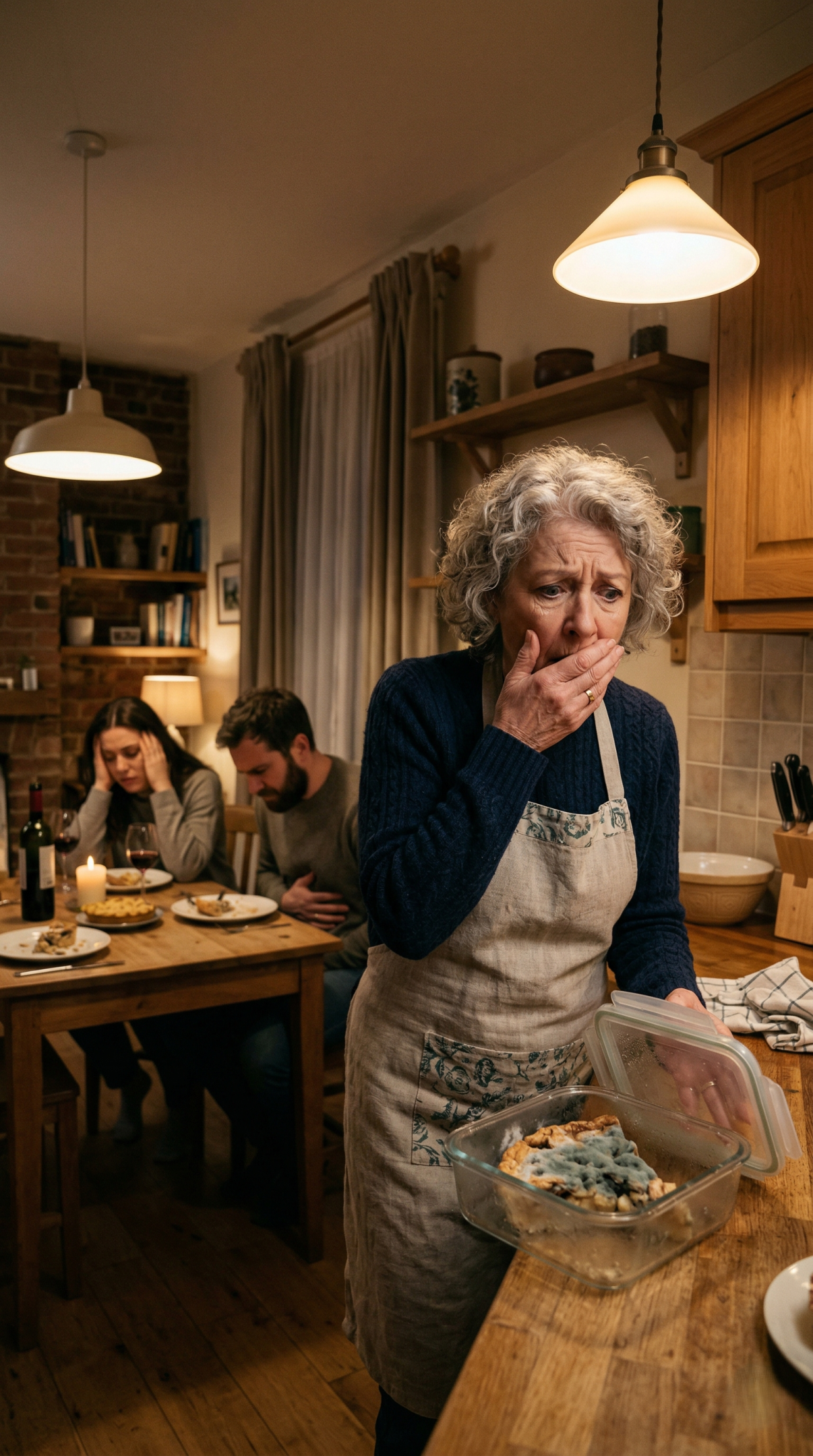
The container.
It sat slightly off to the side, partially closed, as if it had been set down quickly without much thought.
Inside were the leftovers of the pie.
I don’t know why I opened it.
But I did.
And the moment I did, everything changed.
The smell hit first—faint, but unmistakable. Not the sweet scent of dessert, but something sour, something wrong.
Then I saw it.
Mold.
Not just a small spot.
A lot of it.
Spreading across the surface in a way that made it impossible to ignore.
My stomach turned—not just from the illness, but from the realization.
This wasn’t a mistake in baking.
This wasn’t a failed recipe.
This was something else entirely.
I looked closer.
The edges of the container.
The packaging.
And suddenly, it became clear.
This wasn’t homemade.
It was store-bought.
Still in its original packaging, slightly altered but not enough to hide its origin completely.
A quiet detail that now felt loud.
My hands moved almost automatically as I checked the label.
And there it was.
The expiration date.
Two weeks ago.
For a moment, I just stood there.
Still.
Processing.
Trying to make sense of what I was seeing.
Because this wasn’t just about spoiled food.
It was about intention.
About choices.
About something that didn’t quite add up.
Why would she bring this?
Why wouldn’t she check?
Why would she serve something like this without knowing?
The questions came quickly—but the answers didn’t.
That night passed in discomfort.
Physical and emotional.
Because being sick is one thing.
But realizing the reason behind it—that’s something else entirely.
The next day, I knew I had to say something.
Not out of anger.
Not out of accusation.
But out of necessity.
So I approached it gently.
Carefully.
I didn’t want to embarrass her. I didn’t want to create conflict where understanding might exist.
When I brought it up, she didn’t deny it.
She didn’t deflect.
She didn’t make excuses.
Instead, she hesitated.
And then she told the truth.
She had been ashamed.
Ashamed of not knowing how to bake.
Ashamed of feeling like she had nothing to contribute.
Ashamed of being compared—perhaps silently, perhaps only in her own mind—to expectations she felt she couldn’t meet.
So she did what she thought would fix it.
She bought a pie.
In a rush.
Without checking the date.
Hoping it would be enough.
Hoping no one would notice.
And in that moment, the situation shifted.
Because what had felt careless… now felt human.
Not acceptable.
Not excusable.
But understandable.
The pie wasn’t just expired.
It was a reflection of something deeper.
Insecurity.
Pressure.
The quiet fear of not being enough.
And somehow, that made the situation more complicated—not less.
Because now, it wasn’t just about what happened.
It was about why.
And the truth is, sometimes people make poor decisions not because they don’t care—but because they care too much about how they’re perceived.
That doesn’t erase the consequences.
It doesn’t undo the harm.
But it adds a layer of understanding that changes how you respond.
I could have been angry.
I could have made it into something bigger.
But instead, I chose something else.
I chose to see the moment for what it was.
Not just a mistake.
But a lesson.
Because in the end, the expired pie didn’t just make us sick.
It revealed something that might have otherwise stayed hidden.
And sometimes, the things we wish hadn’t happened…
Are the very things that bring the truth to the surface.