
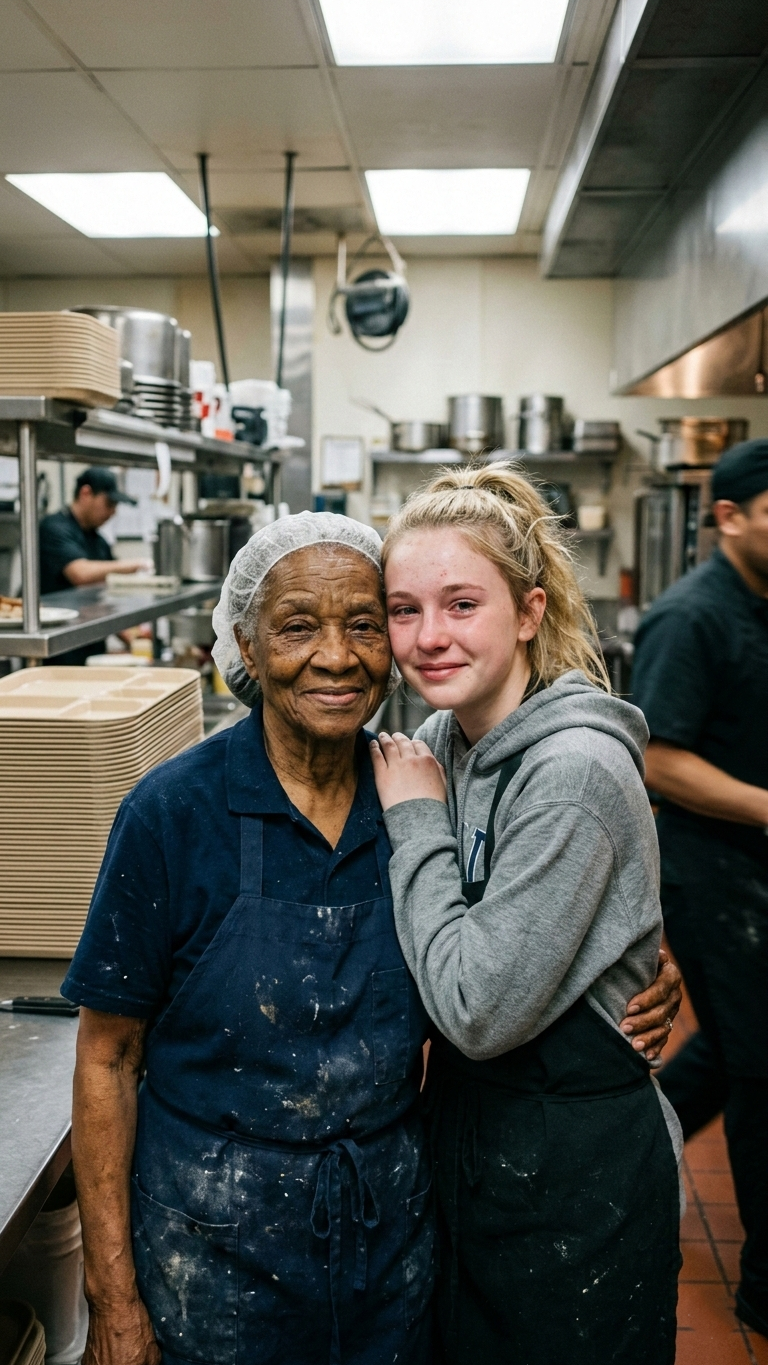
I’m 18 years old, and just last week I walked across the stage and graduated from high school, but ever since that day people keep asking me what I’m going to do next with my life, and the truth is I honestly don’t have an answer because nothing feels like it’s beginning at all.
Instead of feeling excited or hopeful about the future the way everyone expects a graduate to feel, it strangely feels like something in my life ended too suddenly, and the whole world somehow forgot to press the “play” button again so everything could keep moving forward.
Even now, days after graduation, everything around me still smells faintly like the school cafeteria—warm dinner rolls fresh from the ovens, the sharp scent of floor wax shining under fluorescent lights, and the clean chemical smell of disinfectant spray lingering in the air.
Sometimes when I sit quietly at home I swear I can almost hear her footsteps moving slowly across the kitchen floor, even though deep down I know there’s no one there anymore.
My grandmother Lorraine was the one who raised me from the very beginning, and she wasn’t just a grandmother to me but the entire foundation of my life, the person who became my mother, my father, and every single support beam holding up the fragile little world we built together.
When my parents died in a terrible car crash while I was still a toddler too young to remember their faces, she stepped forward without hesitation and took me into her arms as if there had never been any other choice.
She was only fifty-two years old at the time she decided to start over and raise a small child again, even though she was already working full time as a cafeteria cook at the same public school I would eventually attend years later.
The house we lived in was older than anyone in our neighborhood, its wooden floors creaking and groaning whenever the wind shifted outside or a storm rolled through town.
There was never any safety net waiting for us or relatives lined up to help if things went wrong.
It was just the two of us standing together against a world that never slowed down long enough to notice how hard she was working to keep us afloat.
Her name was Lorraine, but inside the school building most people didn’t call her that because to them she was simply “Miss Lorraine” or, more commonly, just “the Lunch Lady,” as if her entire identity could be reduced to the anonymous title of the woman standing behind the cafeteria counter.
But to me she was the most extraordinary person I had ever known, the woman who had quietly helped raise half the kids in our small town whether they realized it or not.
She was seventy years old by the time I reached my senior year of high school, yet she still woke up before dawn every single morning to get ready for work and arrive at the cafeteria long before the students poured into the halls.
Her thin gray hair was always tied back in a colorful scrunchie that she had sewn herself from leftover pieces of fabric she collected.
Every apron she wore seemed to tell its own cheerful story, stitched from bright patterns of sunflowers, strawberries, or red and white checkers that looked like picnic blankets.
She once told me she made them colorful because when kids saw bright patterns it sometimes made them smile, even on bad days.
Every morning before I left for school she would pack my lunch with careful attention and slip a small sticky note inside the bag.
Sometimes the notes said things like “You’re my favorite miracle,” written in her looping handwriting.
Other days they carried playful threats like “Eat the fruit or I’ll haunt you,” which always made me laugh when I opened the bag at lunchtime.
We didn’t have much money at all, but she had a special way of making our life feel full rather than empty.
When the heater broke during the winter she refused to complain and instead lit candles around the living room, wrapped us both in blankets, and cheerfully declared that we were having a “spa night.”
When prom season arrived and everyone else was buying expensive dresses, she found mine for eighteen dollars at a thrift store downtown.
Then she spent three evenings sitting by the kitchen lamp carefully stitching tiny rhinestones onto the straps while softly humming old Billie Holiday songs.
As she worked she would glance up at me with warm eyes and say quietly, “I just want you to be okay.”
For most of my childhood I was okay, but when high school began things slowly started to change.
The whispers began during freshman year, quiet at first but sharp enough to sting when they reached my ears in the crowded hallways.
Sometimes students would walk past me and mutter cruel jokes under their breath like, “Better not talk back to her or her grandma might spit in your soup.”
Others started calling me names like “Lunch Girl” or “PB&J Princess,” turning my grandmother’s job into a punchline.
They mocked the soft Southern accent she carried with her and laughed at the way she called everyone “sugar” or “honey” when handing them their trays.
One afternoon a girl named Brittany leaned across a lunch table surrounded by her friends and loudly asked, “Does your grandma still pack your panties with your lunch?”
The entire table burst into laughter that echoed across the cafeteria walls.
I didn’t laugh.
Several teachers were close enough to hear the comment, but none of them stepped in or said a single word to stop it.
I tried to protect my grandmother from those moments, pretending everything was fine whenever I saw her after school.
But she knew anyway.
She heard the quiet snickers when she walked by and saw the sideways looks students exchanged behind her back.
Yet she never changed the way she treated them.
She continued slipping extra apples or cookies onto the trays of kids who looked hungry and always asked about their sports games or school plays.
Meanwhile I threw myself into studying as hard as I could, burying my head in textbooks, scholarship applications, and dreams of leaving that small town behind.
Then during the spring of my senior year, everything in my life suddenly changed.
It started with her mentioning a tight feeling in her chest one evening after dinner.
“Probably just the chili,” she joked with a small laugh when I told her she should see a doctor.
I begged her to make an appointment anyway, but she kept shaking her head and saying, “Let’s just get you across that graduation stage first.”
One quiet Thursday morning I woke up and noticed the house felt strangely silent in a way that made my stomach twist with unease.
When I walked into the kitchen I found her lying on the floor, curled slightly on her side with her glasses resting beside her hand.
The coffeepot was still half full on the counter.
I screamed for help and tried desperately to perform CPR just like I had seen in videos online.
But by the time the paramedics arrived it was already too late.
They said the words “heart attack” in calm professional voices while the world around me collapsed into silence.
She was gone before the next sunrise ever came.
Later I discovered that she had been secretly saving money all year long for my graduation ceremony, even taking extra shifts at the cafeteria so she could afford the honor cords I had earned.
So when the ceremony arrived, I forced myself to go.
I wore the same dress she had picked for me months earlier.
I walked into that crowded gymnasium feeling like every bone in my body was made of grief and glass.
When the principal called my name for the student speech I stepped onto the stage, but instead of looking down at the notes I had prepared, I raised my eyes and looked out at the audience.
“Most of you knew my grandmother,” I said slowly into the microphone as the room fell quiet.
I told them how she had served them thousands of meals over the years while they laughed at her accent and rolled their eyes behind her back.
I told them she had heard every cruel joke and insult that echoed through that cafeteria.
And despite all of it, she kept showing them kindness anyway.
“She mattered more than any of you will ever understand,” I said with my voice shaking.
The silence inside the gym grew so heavy it felt like the air itself had turned to lead.
I saw teachers lowering their heads and students wiping tears from their cheeks.
When I finished and walked off the stage, the applause that followed was not loud or wild but slow, steady, and deeply sincere.
Later in the hallway Brittany approached me with red swollen eyes and a trembling voice.
“I’m sorry,” she whispered quietly. “We were so mean… we didn’t think about how it felt.”
For the first time all those people who had once laughed suddenly looked small, embarrassed, and ashamed of themselves.
A group of teachers and students told me they wanted to plant a walkway lined with trees leading to the cafeteria entrance and name it “Lorraine’s Way.”
That evening I returned to the house that now felt painfully empty without her laughter filling the rooms.
I sat alone at the kitchen table and stared at the small hook on the wall where her aprons used to hang.
It was empty now.
Softly, almost like a prayer, I whispered into the quiet room, “They’re going to plant trees for you.”
No voice answered me.
But for the first time since she died, the silence around me didn’t feel quite so lonely.
Somewhere deep in my heart I like to believe she heard what I said.
She taught me how to love people loudly, how to endure cruelty without becoming cruel myself, and how to forgive even when it hurts.
And maybe, if I carry those lessons forward into the world, I can someday become someone else’s guiding star the same way she was mine.